
Engineering
A Revolutionary Laser Technology Allows Real-Life Sci-Fi Holograms
Researchers come up with printing images onto the air with light.

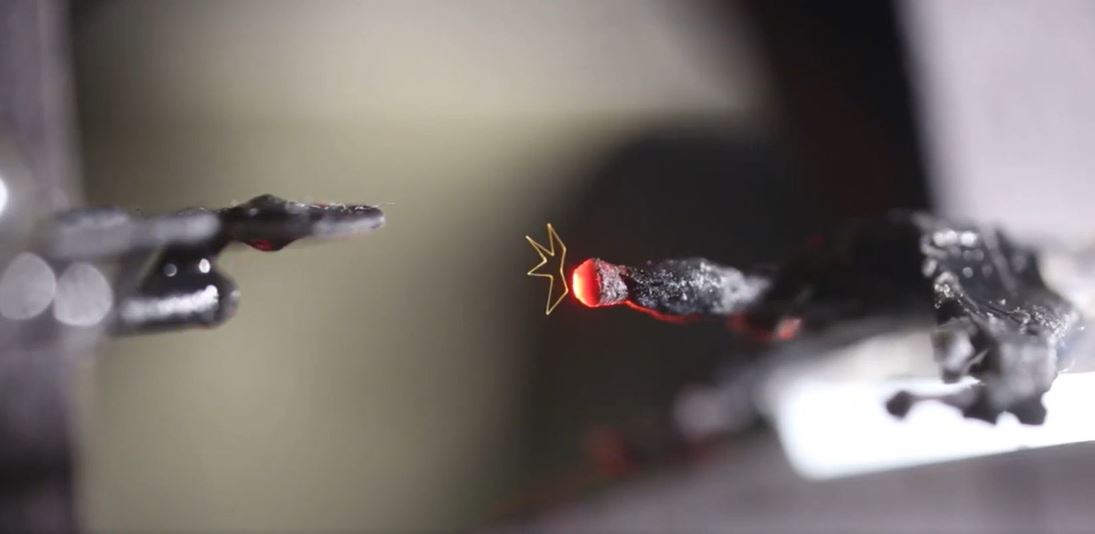
Most people wanted the holographic laser technology of science fiction movies where the image freely floats in the air. Well, sorry to disappoint you, we are not there yet. However, researchers at Brigham Young University came very close to that point. The team developed a technology called “Optical Trap Display” in which light is trapped and reshaped to represent the desired image or model.
As the “Smalley Holography” group, you can find all their work and their amazing gallery taken by Leia, their volumetric display named after Princess Leia from Star Wars from their website. Their findings of the optical trap displays are also published at Scientific Reports with the title of “Simulating virtual images with optical trap displays”.
How does the new laser technology work?
The technology works by “confining a particle in a photophoretic trap” in which the particles is “dragged” to draw the outline for the shape. And as the basic principle of creating a video or a still image, you draw the frames faster than your eye catches. In the end, you get an image or a moving video in the air drawn by a light particle. However, as the main problem of this new technology, the scaling is very small. Controlling the particle gets harder if OTD is scaled for bigger volumes, so for now, most images are kept within the 1 cubic centimeter volume range. The researchers are still pushing new solutions for scalability in laser technology.
As the method innately suggests, the new technology was named “Optical Trap Display” since it traps the light in a certain pathway to represent an image. You can read about it in detail in their research paper to give them support as well. Visit their gallery for stunning images.
Hologram fictional representation. Credit: Pixabay
The use cases
Well, for now, it does not seem very scalable. However, in their reporting video, the team actually creates a use case for movies and artworks with the help of perspective and parallax effects. Hologram technology is not very new, but previous versions are even less scalable than this one due to the high requirement for computational power.
So, it is natural to suggest that with good scalability solutions, this laser technology can be the first step in creating virtual reality in the real world, without the headsets and such. I have written about metaverse a lot of times in my previous articles, maybe it would be good to be in metaverse without getting skin rashes from the headsets. Anyways, it always puts a smile when sci-fi dreams become reality with this kind of laser technology and brilliant research.
Reference: Rogers, W., Smalley, D. Simulating virtual images in optical trap displays. Sci Rep 11, 7522 (2021). https://doi.org/10.1038/s41598-021-86495-6
Disclaimer: This content is not sponsored. In the case of any dispute over the material, reach out to the website through given contacts and the necessary action will be taken.

Mariana Trench: 8 Fascinating Facts About the Earth’s Deepest Place
10 most famous scientists who contributed to astronomy and space

Top 25 extremely stunning photos of Northern Lights of 2020 revealed

Meteorite makes Indonesian man a millionaire as piece crashes through his roof

It’s Now Possible to Predict Blood Cancer With Ten-Second Videos
This Inexpensive Method Speeds up Analysis of 3D Printed Metal Parts

SpaceX Dragon: A Game Changer for NASA
Tiny fish, big boom: This small fish found to roar like a gunshot

Turkish city unveils design of Mars Colony project for tourists

Researchers Reveal the Source of the Electron Rain Phenomenon
A New Study Reveals How Climate Change Will Affect Sound Travels Underwater
Here Are 6 Space Technologies We Can Benefit to Improve Life on Earth
SpaceX Announced Crew Dragon Will No Longer Be Produced
Russia Warns Sanctions on Moscow Could Endanger the ISS
A New Study Reveals How to Make Walking Easier

Remote-control cars to race on the Moon in 2021
Space Debris Problem Is Getting Worse: Causes and Removal Efforts of Rambling Junk

Microplastic Pollution Detected in Human Blood for the First Time

Nvidia CEO declares coding’s end in AI era

Here Is Blue Origin’s Touristic Rocket: The New Shepard Design
The Fastest Manned Plane in the World: Here’s The Insane Engineering of the X-15
Here Are 6 Space Technologies We Can Benefit to Improve Life on Earth
Pentagon Formed A New Group To Investigate UFO Reports
Space Debris Problem Is Getting Worse: Causes and Removal Efforts of Rambling Junk
From New Zealand to the US: The Rocket Lab Story
Here Is Blue Origin’s Touristic Rocket: The New Shepard Design

Take a Look at Earth From Space: Glasgow, Scotland
NASA Is Preparing Next Generation Spacesuits for Moon Mission and Beyond
Remote-control cars to race on the Moon in 2021
Meteorite makes Indonesian man a millionaire as piece crashes through his roof
NASA sends a new Space toilet for astronauts to ISS

 Earth & Energy5 years ago
Mariana Trench: 8 Fascinating Facts About the Earth’s Deepest Place

 Space6 years ago
10 most famous scientists who contributed to astronomy and space
- Skywatching6 years ago
Top 25 extremely stunning photos of Northern Lights of 2020 revealed
- Engineering6 years ago
Meteorite makes Indonesian man a millionaire as piece crashes through his roof

 Science5 years ago
It’s Now Possible to Predict Blood Cancer With Ten-Second Videos
 Engineering5 years ago
This Inexpensive Method Speeds up Analysis of 3D Printed Metal Parts
- Infographic6 years ago
SpaceX Dragon: A Game Changer for NASA

 Earth & Energy3 years ago
Tiny fish, big boom: This small fish found to roar like a gunshot