
Engineering
2D-3D Shell Structure Allows Successful Eco-friendly Flexible Printed Electronics
Paving the way for flexible circuits.

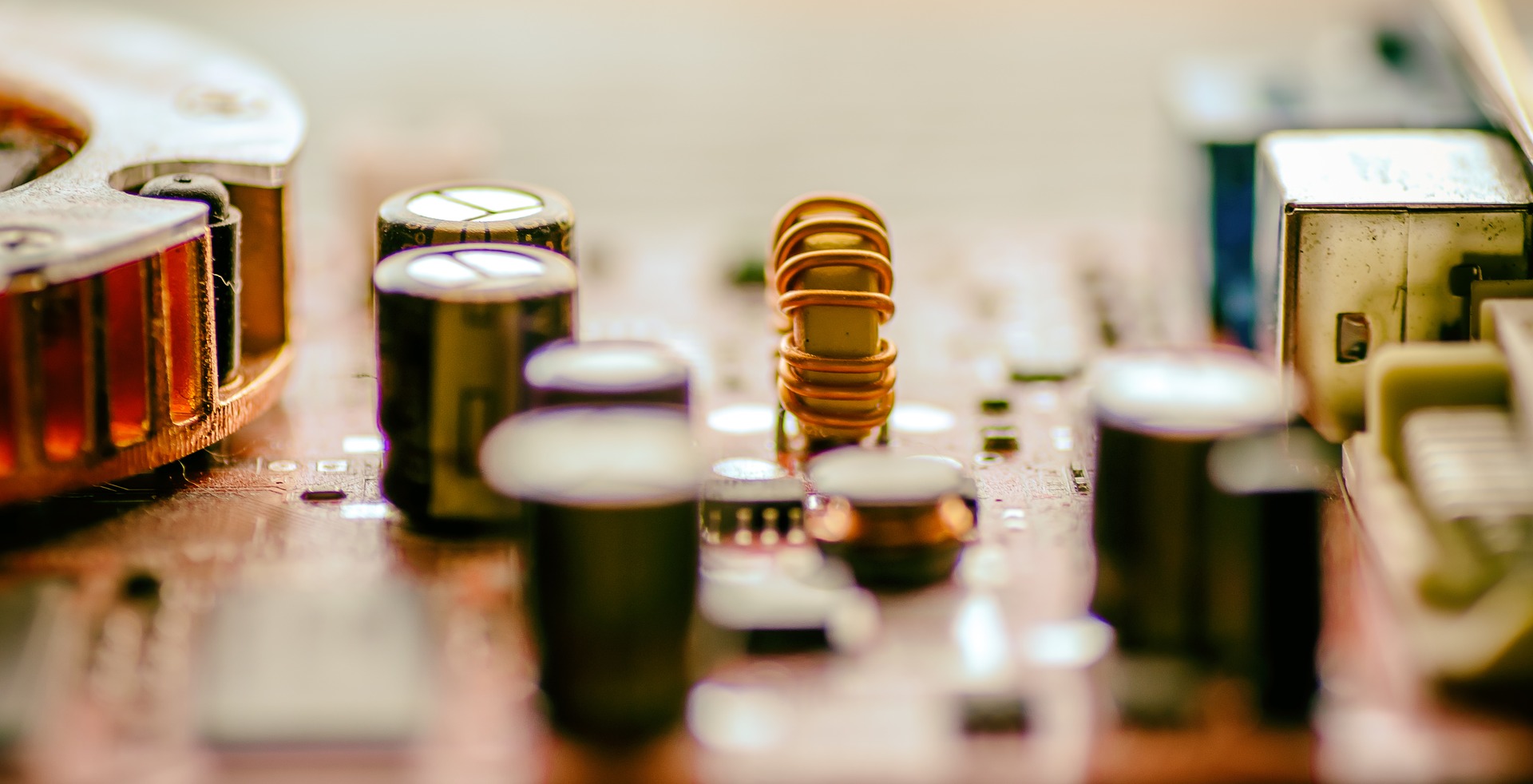
High-performance flexible electronics is a big target for engineering, and an environmentally benign one would be even more useful. Now, using a “shell structure”, researchers at the Tokyo Institute of Technology have developed a thin film transistor (TFTs) that is “flexible”, “printable” and “environmentally benign”.
Researchers have published their work in Advanced Science with the title of “High-Performance P-Channel Tin Halide Perovskite Thin Film Transistor Utilizing a 2D–3D Core-Shell Structure“. While the semiconductor industry is still facing a chip shortage, this improvement in metal halide perovskites (MHPs) may lead to better solutions for the future of the semiconductor industry.
What is the technology behind the new electronics?
MHPs have long experimented with materials within the electronics industry but they have their issues such as their performance and thresholds. While there are two types of MHPs, one being 2D and the other being 3D, there are also 2 different problems to solve. “2D MHPs have grain boundary issues”, decreasing conductivity, and “3D MHPs have high hole density” which means that they have bigger threshold voltages to work, affecting performance. Most materials used in production are also harmful to the environment since they usually contain lead.
With their new material, the team solves these individual problems with their new 2D/3D structure. With this innovation, solving alignment problems and isolating 3D MHP structures with linking them to 2D ones; resolve both the problems mentioned. While the alignment solves boundary issues, isolating 3D structures resolve the threshold voltage problems. Also, the material is mostly made with zinc, an environmentally benign and mostly sustainable resource. Another advantage of the new system is that it allows for “high performance” flexible and printed electronics with a mosaic-like structure.
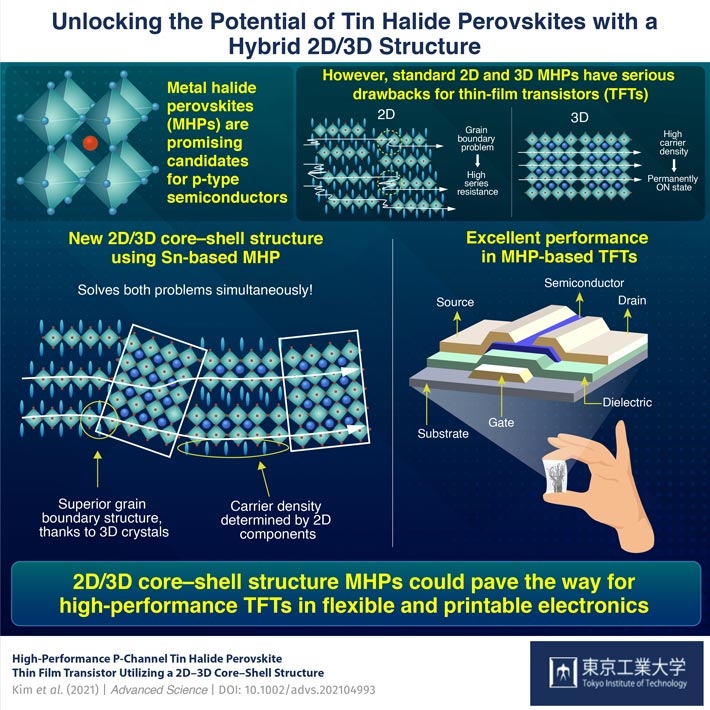
2D/3D structure Credit: Tokyo Institute of Technology Press Release
The technology of the future
With a lot of space-based research and sustainability actions around the world, printable sustainable electronics have become a need. While achieving these criteria of the future, new products are also required to bring their own edge to the industry. This one is stellar research that brings both to the table, with still having a lot of technical details and improvements to be made.
The future of the machinery would be practical, built-on-the-way, flexible smart machines that require a combination of every engineering field. This one, with the previous research from someone else (Read: This Novel Technology Stores Wind Power Under Water), and the ones that came before will lead to the future of engineering and electronics.
Reference
, , , , , , , , High-Performance P-Channel Tin Halide Perovskite Thin Film Transistor Utilizing a 2D–3D Core–Shell Structure. Adv. Sci. 2021, 2104993. https://doi.org/10.1002/advs.202104993

Mariana Trench: 8 Fascinating Facts About the Earth’s Deepest Place
10 most famous scientists who contributed to astronomy and space

Top 25 extremely stunning photos of Northern Lights of 2020 revealed

Meteorite makes Indonesian man a millionaire as piece crashes through his roof

It’s Now Possible to Predict Blood Cancer With Ten-Second Videos
This Inexpensive Method Speeds up Analysis of 3D Printed Metal Parts

SpaceX Dragon: A Game Changer for NASA
Tiny fish, big boom: This small fish found to roar like a gunshot

Turkish city unveils design of Mars Colony project for tourists

Researchers Reveal the Source of the Electron Rain Phenomenon
A New Study Reveals How Climate Change Will Affect Sound Travels Underwater

Here Are 6 Space Technologies We Can Benefit to Improve Life on Earth

SpaceX Announced Crew Dragon Will No Longer Be Produced
Russia Warns Sanctions on Moscow Could Endanger the ISS
A New Study Reveals How to Make Walking Easier

Remote-control cars to race on the Moon in 2021

Space Debris Problem Is Getting Worse: Causes and Removal Efforts of Rambling Junk

Microplastic Pollution Detected in Human Blood for the First Time

Nvidia CEO declares coding’s end in AI era

Here Is Blue Origin’s Touristic Rocket: The New Shepard Design

The Fastest Manned Plane in the World: Here’s The Insane Engineering of the X-15
Here Are 6 Space Technologies We Can Benefit to Improve Life on Earth
Pentagon Formed A New Group To Investigate UFO Reports
Space Debris Problem Is Getting Worse: Causes and Removal Efforts of Rambling Junk
From New Zealand to the US: The Rocket Lab Story
Here Is Blue Origin’s Touristic Rocket: The New Shepard Design

Take a Look at Earth From Space: Glasgow, Scotland

NASA Is Preparing Next Generation Spacesuits for Moon Mission and Beyond
Remote-control cars to race on the Moon in 2021
Meteorite makes Indonesian man a millionaire as piece crashes through his roof
NASA sends a new Space toilet for astronauts to ISS

 Earth & Energy5 years ago
Mariana Trench: 8 Fascinating Facts About the Earth’s Deepest Place

 Space6 years ago
10 most famous scientists who contributed to astronomy and space
- Skywatching6 years ago
Top 25 extremely stunning photos of Northern Lights of 2020 revealed
- Engineering6 years ago
Meteorite makes Indonesian man a millionaire as piece crashes through his roof

 Science5 years ago
It’s Now Possible to Predict Blood Cancer With Ten-Second Videos
 Engineering5 years ago
This Inexpensive Method Speeds up Analysis of 3D Printed Metal Parts
- Infographic6 years ago
SpaceX Dragon: A Game Changer for NASA

 Earth & Energy3 years ago
Tiny fish, big boom: This small fish found to roar like a gunshot