
Space
Scientists Extract Gases From Lunar Soil Collected on Moon’s Surface 50 Years Ago
“Stay tuned for interesting results to come!”

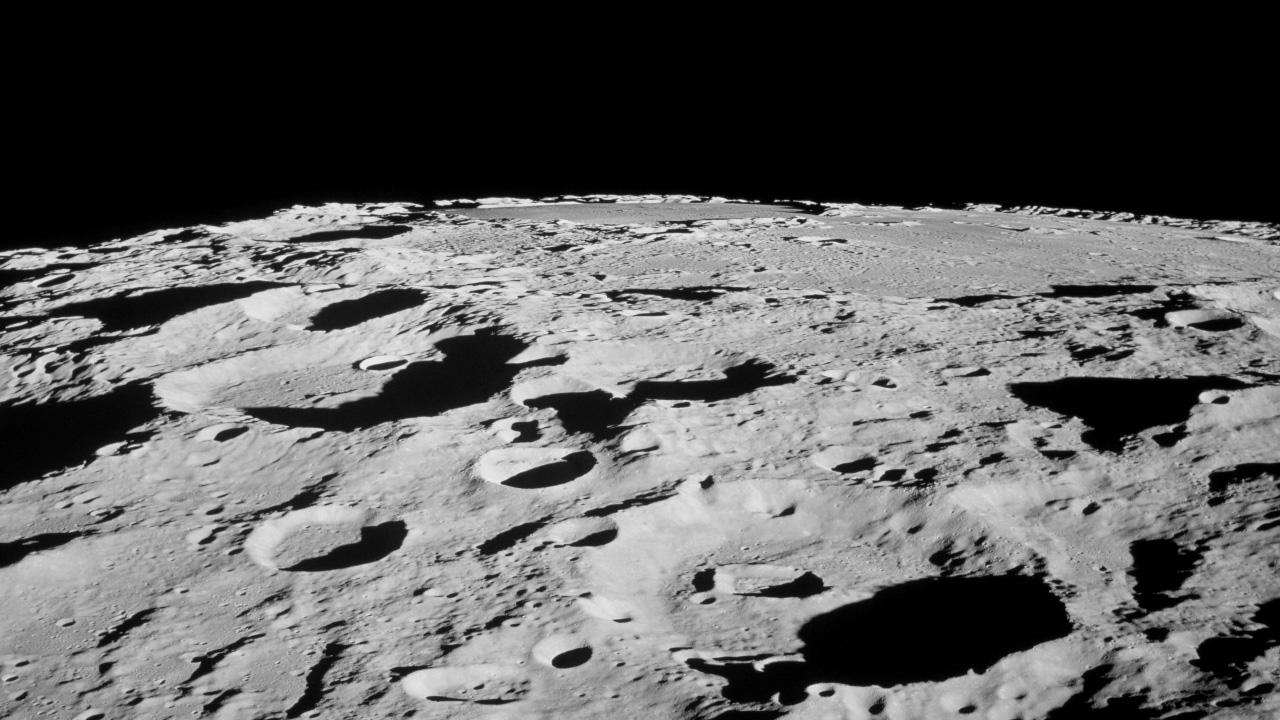
In 1972, Apollo 17 astronauts Harrison Schmitt and Eugene Cernan recovered gases from a vacuum lunar soil container they collected from a field in the Moon’s Taurus-Littrow Valley.
At that time, astronauts dug a column of lunar regolith, a mixture of dust, earth, and rock, with a core drill and compacted it in a container, and when they returned, placed it in the lunar vault at NASA’s Johnson Space Center. This sample has remained untouched and undisturbed until now as part of NASA’s Apollo Next Generation Sample Analysis (ANGSA). The containers containing the sample were placed in two sealed Teflon bags and stored in a nitrogen glove box.
Alex Meshik, Professor of Physics at the University of Washington, and his collaborators will now be able to recognize the original chemical signature of each gas fragment and perform several extractions at different volumes under different conditions, with the extraction method they performed last month to measure the gases in the container in which the sample is located.
“To help us make the informed decisions during these extractions, we incorporated into the apparatus a mass spectrometer for real-time compositional analyses of the gas, and three high-precision capacitance manometers for nondestructive and gas-independent pressure measurements,” Meshik said.
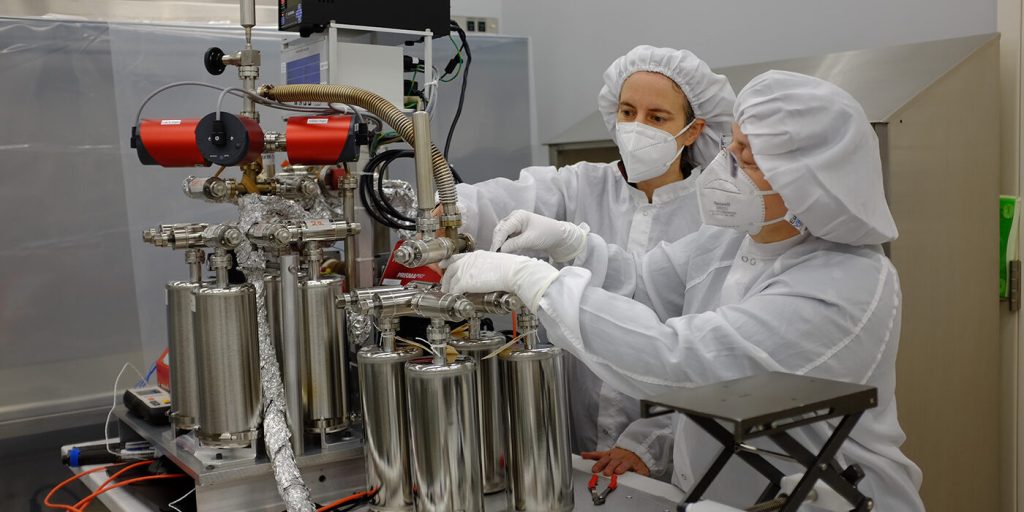
Photo: Alex Meshik
Samples from the Moon were collected back in 1972
Brad Jolliff, Professor of Earth and Planetary Sciences and Director of the McDonnell Center for Space Sciences, said, “Fifty years ago, when these samples were collected, NASA scientists had the foresight to put in place curation procedures that would ensure future generations access to pristine samples when new analytical methods and procedures would be available, and new scientific questions would be asked”.
“At Washington University, we have several cutting-edge labs looking at various aspects of these precious samples and testing hypotheses about their origins and how they fit into a modern context of planetary science,” said Jolliff, who is also an institutional principal investigator at the University of Washington.
Interesting results are on the way
“The noble gas studies are a great example because they contain not only much information about present-day implantation of material from the sun into the surface of the moon, but also about the very origin of the moon four and a half billion years ago. Stay tuned for interesting results to come!”
Preliminary results will be discussed at the Lunar and Planetary Sciences conference that will be hosting its guests in Houston on March 7-11.
Lunar gases from storage containers are collected using the extraction manifold apparatus. After the gases trapped in the containers are collected, the team plans to allow other gases to slowly disperse from the moon rocks.
Following the process, NASA plans to ship the gases to selected laboratories in the US and Europe, including the University of Washington, which specialize in high-precision analyzes of oxygen, nitrogen, noble gases and organics.

Mariana Trench: 8 Fascinating Facts About the Earth’s Deepest Place
10 most famous scientists who contributed to astronomy and space

Top 25 extremely stunning photos of Northern Lights of 2020 revealed
Meteorite makes Indonesian man a millionaire as piece crashes through his roof
It’s Now Possible to Predict Blood Cancer With Ten-Second Videos
This Inexpensive Method Speeds up Analysis of 3D Printed Metal Parts

SpaceX Dragon: A Game Changer for NASA
Tiny fish, big boom: This small fish found to roar like a gunshot

Turkish city unveils design of Mars Colony project for tourists

Researchers Reveal the Source of the Electron Rain Phenomenon
A New Study Reveals How Climate Change Will Affect Sound Travels Underwater
Here Are 6 Space Technologies We Can Benefit to Improve Life on Earth
SpaceX Announced Crew Dragon Will No Longer Be Produced
Russia Warns Sanctions on Moscow Could Endanger the ISS
A New Study Reveals How to Make Walking Easier

Remote-control cars to race on the Moon in 2021
Space Debris Problem Is Getting Worse: Causes and Removal Efforts of Rambling Junk
Microplastic Pollution Detected in Human Blood for the First Time

Nvidia CEO declares coding’s end in AI era
Here Is Blue Origin’s Touristic Rocket: The New Shepard Design
The Fastest Manned Plane in the World: Here’s The Insane Engineering of the X-15
Here Are 6 Space Technologies We Can Benefit to Improve Life on Earth
Pentagon Formed A New Group To Investigate UFO Reports
Space Debris Problem Is Getting Worse: Causes and Removal Efforts of Rambling Junk
From New Zealand to the US: The Rocket Lab Story
Here Is Blue Origin’s Touristic Rocket: The New Shepard Design
Take a Look at Earth From Space: Glasgow, Scotland
NASA Is Preparing Next Generation Spacesuits for Moon Mission and Beyond
Remote-control cars to race on the Moon in 2021
Meteorite makes Indonesian man a millionaire as piece crashes through his roof
NASA sends a new Space toilet for astronauts to ISS

 Earth & Energy5 years ago
Mariana Trench: 8 Fascinating Facts About the Earth’s Deepest Place

 Space6 years ago
10 most famous scientists who contributed to astronomy and space
- Skywatching6 years ago
Top 25 extremely stunning photos of Northern Lights of 2020 revealed
- Engineering6 years ago
Meteorite makes Indonesian man a millionaire as piece crashes through his roof

 Science5 years ago
It’s Now Possible to Predict Blood Cancer With Ten-Second Videos
 Engineering5 years ago
This Inexpensive Method Speeds up Analysis of 3D Printed Metal Parts
- Infographic6 years ago
SpaceX Dragon: A Game Changer for NASA

 Earth & Energy3 years ago
Tiny fish, big boom: This small fish found to roar like a gunshot