
Space
Life on Other Planets? Astronomers Identify Largest Molecule Ever in Planet-Forming Disk
A sign of potential to host life.

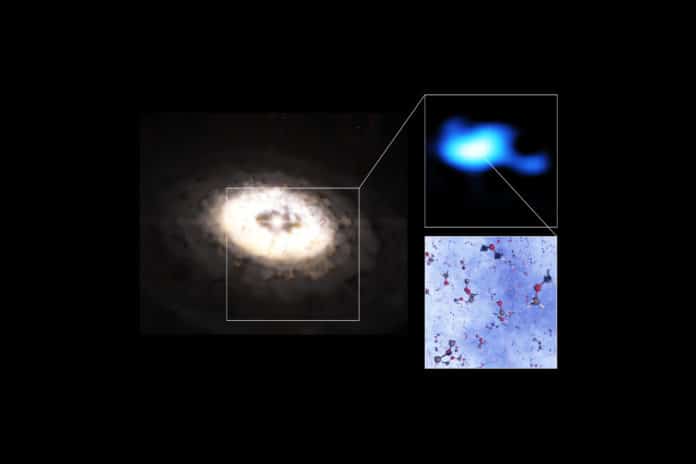
A precursor to an organic molecule that would give rise to life has been identified in a planet-forming gas disk around a young star called Oph-IRS 48. The dimethyl ether molecule found in the disk by the team is usually found in stars that form clouds.
Leiden Observatory Assistant Professor Nienke van der Marel told Newsweek: “Dimethyl ether is the largest molecule ever detected in a planet-forming disk. It has been seen before in cold clouds where stars form, but not yet in a medium where planets form.
The importance of the molecule discovered by astronomers
“This means that such molecules can reach the planets directly as soon as they form. The molecule is particularly important as it is a ‘complex organic molecule’ that is the starting point for large molecules, the building blocks of life, through further chemicals.”
“These results give us a better understanding of complex organic molecules and how they eventually come together,” said Nashanty Brunken, a Master’s student at the Leiden Observatory.
Because these molecules are the precursors of life’s building blocks, the results could help show which system and planet are more likely to host life. Brunken also said, “Complex organic molecules are precursors to pre-life molecules. This means that from molecules such as dimethyl ether, we can build larger and more complex molecules, such as amino acids and sugars, which are components of life.”
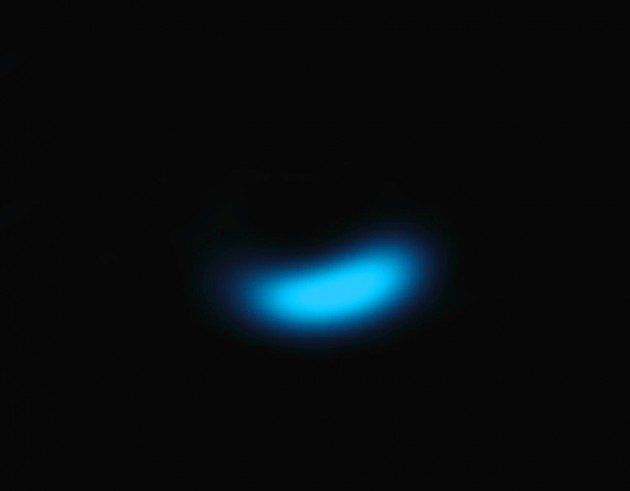
Credit: ALMA (ESO/NAOJ/NRAO) Nienke van der Marel)
‘All exoplanet systems have the potential to host life’
Alice Booth, a Leiden University astronomer and co-author of the paper, told Newsweek: “The detection of these complex molecules in the hot disk-like IRS 48, which they were unable to form in situ, is very convincing evidence for interstellar inheritance. This means that the complex molecules in the disks have an origin in the cold black cloud stage before stars form. If you can guess that, then it means that all exoplanet systems have the potential to host life.”
In the young star IRS 48, there is an asymmetrical, “dust trap” that has been caused by the birth of a planet or star between the parent star and the dust trap. In this zone, larger dust grains can become trapped and grow larger.
“This discovery tells us that large complex molecules are present where planets form, as the dust trap is probably located at the edge of a cavity carved out by a planet,” said Van der Marel, co-author of the study.
“The dust trap itself is a high concentration of dust grains that can transform into a group of planetoids, comets, or even a planet itself. Knowing that such molecules are found in the region of the disk where planets form tells us on which planets such molecules could end up and potentially develop life.”
The studies were carried out with the ALMA telescope located in the Atacama Desert in Chile. “The ALMA telescope has much higher sensitivity than other telescopes observing at these wavelengths,” van der Marel said.

Mariana Trench: 8 Fascinating Facts About the Earth’s Deepest Place
10 most famous scientists who contributed to astronomy and space

Top 25 extremely stunning photos of Northern Lights of 2020 revealed

Meteorite makes Indonesian man a millionaire as piece crashes through his roof
It’s Now Possible to Predict Blood Cancer With Ten-Second Videos

This Inexpensive Method Speeds up Analysis of 3D Printed Metal Parts

SpaceX Dragon: A Game Changer for NASA
Tiny fish, big boom: This small fish found to roar like a gunshot

Turkish city unveils design of Mars Colony project for tourists

Researchers Reveal the Source of the Electron Rain Phenomenon
A New Study Reveals How Climate Change Will Affect Sound Travels Underwater

Here Are 6 Space Technologies We Can Benefit to Improve Life on Earth

SpaceX Announced Crew Dragon Will No Longer Be Produced
Russia Warns Sanctions on Moscow Could Endanger the ISS
A New Study Reveals How to Make Walking Easier

Remote-control cars to race on the Moon in 2021

Space Debris Problem Is Getting Worse: Causes and Removal Efforts of Rambling Junk

Microplastic Pollution Detected in Human Blood for the First Time

Nvidia CEO declares coding’s end in AI era
Here Is Blue Origin’s Touristic Rocket: The New Shepard Design

The Fastest Manned Plane in the World: Here’s The Insane Engineering of the X-15
Here Are 6 Space Technologies We Can Benefit to Improve Life on Earth
Pentagon Formed A New Group To Investigate UFO Reports
Space Debris Problem Is Getting Worse: Causes and Removal Efforts of Rambling Junk
From New Zealand to the US: The Rocket Lab Story
Here Is Blue Origin’s Touristic Rocket: The New Shepard Design
Take a Look at Earth From Space: Glasgow, Scotland

NASA Is Preparing Next Generation Spacesuits for Moon Mission and Beyond
Remote-control cars to race on the Moon in 2021
Meteorite makes Indonesian man a millionaire as piece crashes through his roof
NASA sends a new Space toilet for astronauts to ISS

 Earth & Energy5 years ago
Mariana Trench: 8 Fascinating Facts About the Earth’s Deepest Place

 Space6 years ago
10 most famous scientists who contributed to astronomy and space
- Skywatching6 years ago
Top 25 extremely stunning photos of Northern Lights of 2020 revealed
- Engineering6 years ago
Meteorite makes Indonesian man a millionaire as piece crashes through his roof

 Science5 years ago
It’s Now Possible to Predict Blood Cancer With Ten-Second Videos
 Engineering5 years ago
This Inexpensive Method Speeds up Analysis of 3D Printed Metal Parts
- Infographic6 years ago
SpaceX Dragon: A Game Changer for NASA

 Earth & Energy3 years ago
Tiny fish, big boom: This small fish found to roar like a gunshot