
Engineering
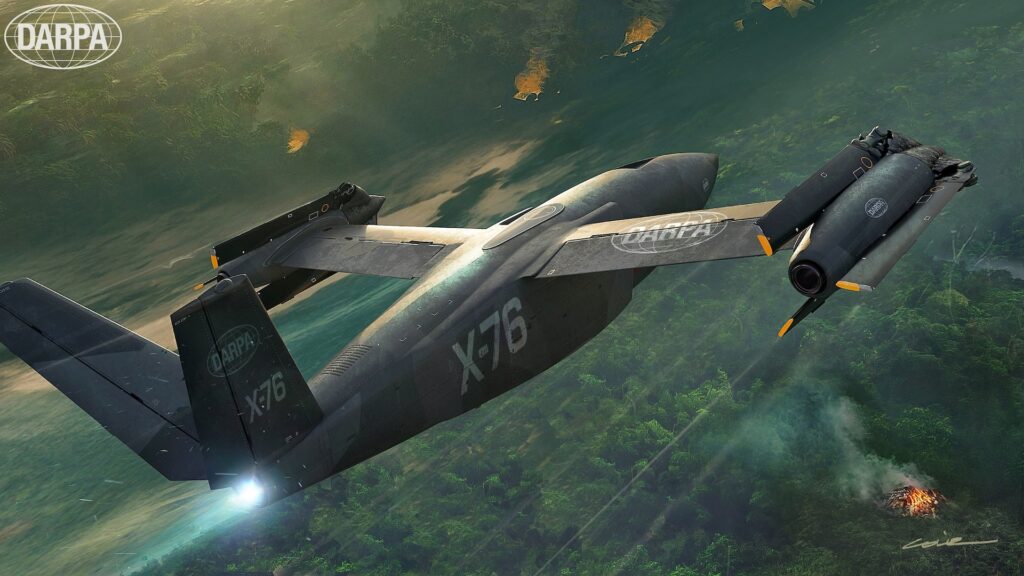
Bell unveils revolutionary X-76 fold-away rotor aircraft for DARPA
X-76 aims to combine helicopter-style vertical takeoff with jet-level speed.


The latest addition to the prestigious X-plane family has officially been announced as Bell Textron’s innovative demonstrator for the Speed and Runway Independent Technologies program. This highly ambitious initiative is run by the Defense Advanced Research Projects Agency in close collaboration with the United States Special Operations Command.
Known simply as SPRINT, the program aims to completely transform how the military deploys aircraft in highly contested combat environments. DARPA officially selected Bell last year over Boeing subsidiary Aurora Flight Sciences to move into the critical experimental flying demonstrator phase.
THE HISTORIC SIGNIFICANCE OF THE X-76 DESIGNATION
The chosen X-76 designation carries a deep historical meaning for the United States defense sector. It specifically references the year 1776, intending to honor the upcoming 250th anniversary of the nation’s founding.
Jason Hurst, Bell’s Senior Vice President of Engineering, proudly noted that the aerospace company is deeply honored to receive this specific designation. He emphasized that this milestone advances the engineering team toward a historic first in aviation while fulfilling their mission to develop next-generation vertical-lift aircraft.
REVOLUTIONARY STOP AND FOLD ROTOR TECHNOLOGY
The fundamental core of the SPRINT initiative is to demonstrate an advanced vertical takeoff and landing aircraft concept for future military operations. This futuristic platform must easily cruise at breathtaking speeds between 400 and 450 knots to meet strict tactical requirements.
Bell’s unique engineering approach centers on highly advanced wingtip proprotors featuring blades that dynamically fold away during operation. This complex mechanical transition occurs right after the aircraft shifts from a stable hover into high-speed level flight.
The aerospace manufacturer officially refers to this groundbreaking mechanism as the Stop/Fold rotor system. While the folding rotors enable vertical maneuvers and hovering, a completely separate traditional jet propulsion system takes over to provide massive forward thrust during cruise mode.
OVERCOMING TRADITIONAL RUNWAY VULNERABILITIES
DARPA recently confirmed that the X-76 successfully completed its critical design review and has officially entered the manufacturing production phase. Once fully constructed, this experimental demonstrator will mature the vital technologies needed to hover in austere environments and operate from completely unprepared surfaces.
Military commanders have long recognized that relying on traditional runways creates a critical operational vulnerability during major global conflicts. Commander Ian Higgins, the DARPA SPRINT program manager, passionately argued that runways have historically acted as both a tactical enabler and a restrictive tether.
According to Higgins, the SPRINT program is not just building another experimental plane, but rather forging entirely new strategic options for battlefield commanders. The ultimate goal is to deliver the powerful element of surprise and life-saving speed anywhere on the globe without requiring a single runway.
SCALABILITY AND FUTURE MISSION PROFILES
The highly anticipated Phase 3 flight-test program for the X-76 demonstrator is currently scheduled to commence in early 2028. Bell engineers have consistently stated that this fold-away rotor technology is highly scalable across various aviation platform sizes.
This design flexibility means the revolutionary concept could theoretically apply to aircraft with gross weights ranging anywhere from 4,000 to an astounding 100,000 pounds. To put this massive scale in perspective, the existing CV-22B Osprey tiltrotor maxes out at 60,500 pounds and only reaches a top speed of 280 knots.
Early SPRINT concepts primarily focused on transporting heavy cargo and frontline personnel to dangerous battlefield locations. However, Bell has already showcased renderings of multiple crewed and uncrewed variations that could eventually be configured for direct offensive combat missions.

TACTICAL ADVANTAGES IN MODERN WARFARE
Aviation experts suggest that an operational aircraft derived from the X-76 could eventually take on highly demanding roles like combat search and rescue. Other potential operational profiles include advanced intelligence gathering, surveillance, air-to-air combat, and precision air-to-surface strikes.
The vital capability to conduct combat search and rescue without needing established infrastructure is becoming increasingly essential for modern military doctrine. This is particularly true when strategizing for potential high-end conflicts against heavily armed adversaries equipped with capable air defense networks in the Indo-Pacific region.
Traditional military bases and established runways in Europe and the Middle East are also facing a rapidly growing range of devastating long-range airborne threats. Therefore, the runway-independent technologies explored by the X-76 demonstrator will be absolutely critical for maintaining air superiority and overall operational flexibility.
Despite decades of extensive research and multiple failed industry attempts to field truly high-speed vertical takeoff platforms, DARPA remains highly optimistic about this venture. The upcoming test flights will ultimately prove whether Bell’s ambitious rotor system is the definitive answer to modern warfare’s most pressing logistical challenges.

Mariana Trench: 8 Fascinating Facts About the Earth’s Deepest Place

10 most famous scientists who contributed to astronomy and space

Top 25 extremely stunning photos of Northern Lights of 2020 revealed

Meteorite makes Indonesian man a millionaire as piece crashes through his roof

It’s Now Possible to Predict Blood Cancer With Ten-Second Videos
This Inexpensive Method Speeds up Analysis of 3D Printed Metal Parts

SpaceX Dragon: A Game Changer for NASA

Tiny fish, big boom: This small fish found to roar like a gunshot

Turkish city unveils design of Mars Colony project for tourists

Researchers Reveal the Source of the Electron Rain Phenomenon

A New Study Reveals How Climate Change Will Affect Sound Travels Underwater

Here Are 6 Space Technologies We Can Benefit to Improve Life on Earth

SpaceX Announced Crew Dragon Will No Longer Be Produced

Russia Warns Sanctions on Moscow Could Endanger the ISS

A New Study Reveals How to Make Walking Easier

Remote-control cars to race on the Moon in 2021

Space Debris Problem Is Getting Worse: Causes and Removal Efforts of Rambling Junk

Microplastic Pollution Detected in Human Blood for the First Time

Nvidia CEO declares coding’s end in AI era

Here Is Blue Origin’s Touristic Rocket: The New Shepard Design

The Fastest Manned Plane in the World: Here’s The Insane Engineering of the X-15
Here Are 6 Space Technologies We Can Benefit to Improve Life on Earth

Pentagon Formed A New Group To Investigate UFO Reports
Space Debris Problem Is Getting Worse: Causes and Removal Efforts of Rambling Junk
From New Zealand to the US: The Rocket Lab Story
Here Is Blue Origin’s Touristic Rocket: The New Shepard Design

Take a Look at Earth From Space: Glasgow, Scotland

NASA Is Preparing Next Generation Spacesuits for Moon Mission and Beyond
Remote-control cars to race on the Moon in 2021
Meteorite makes Indonesian man a millionaire as piece crashes through his roof
NASA sends a new Space toilet for astronauts to ISS

 Earth & Energy5 years ago
Mariana Trench: 8 Fascinating Facts About the Earth’s Deepest Place

 Space6 years ago
10 most famous scientists who contributed to astronomy and space
- Skywatching6 years ago
Top 25 extremely stunning photos of Northern Lights of 2020 revealed
- Engineering6 years ago
Meteorite makes Indonesian man a millionaire as piece crashes through his roof

 Science5 years ago
It’s Now Possible to Predict Blood Cancer With Ten-Second Videos
 Engineering5 years ago
This Inexpensive Method Speeds up Analysis of 3D Printed Metal Parts
- Infographic6 years ago
SpaceX Dragon: A Game Changer for NASA

 Earth & Energy3 years ago
Tiny fish, big boom: This small fish found to roar like a gunshot