
Space
Asteroid Ryugu DNA discovery strengthens theories on cosmic origin of life
Asteroid samples contain all life’s building blocks.


[wpsummarize]The recent asteroid Ryugu DNA discovery provides groundbreaking evidence that the primary building blocks of existence are distributed throughout our solar system.
This revelation comes after a dedicated Japanese research team identified every necessary component for both DNA and RNA within the ancient space rocks.
SCIENTIFIC VERIFICATION OF GENETIC BUILDING BLOCKS
A new study published in the journal Nature Astronomy confirms the presence of all five critical nucleobases in the collected materials. These include adenine, guanine, cytosine, thymine, and the previously detected uracil which serves as a vital messenger in ribonucleic acid.
The research demonstrates that these primitive celestial bodies act as natural laboratories for creating organic molecules. This indicates that the chemistry required for the origin of life was likely present long before Earth became habitable.
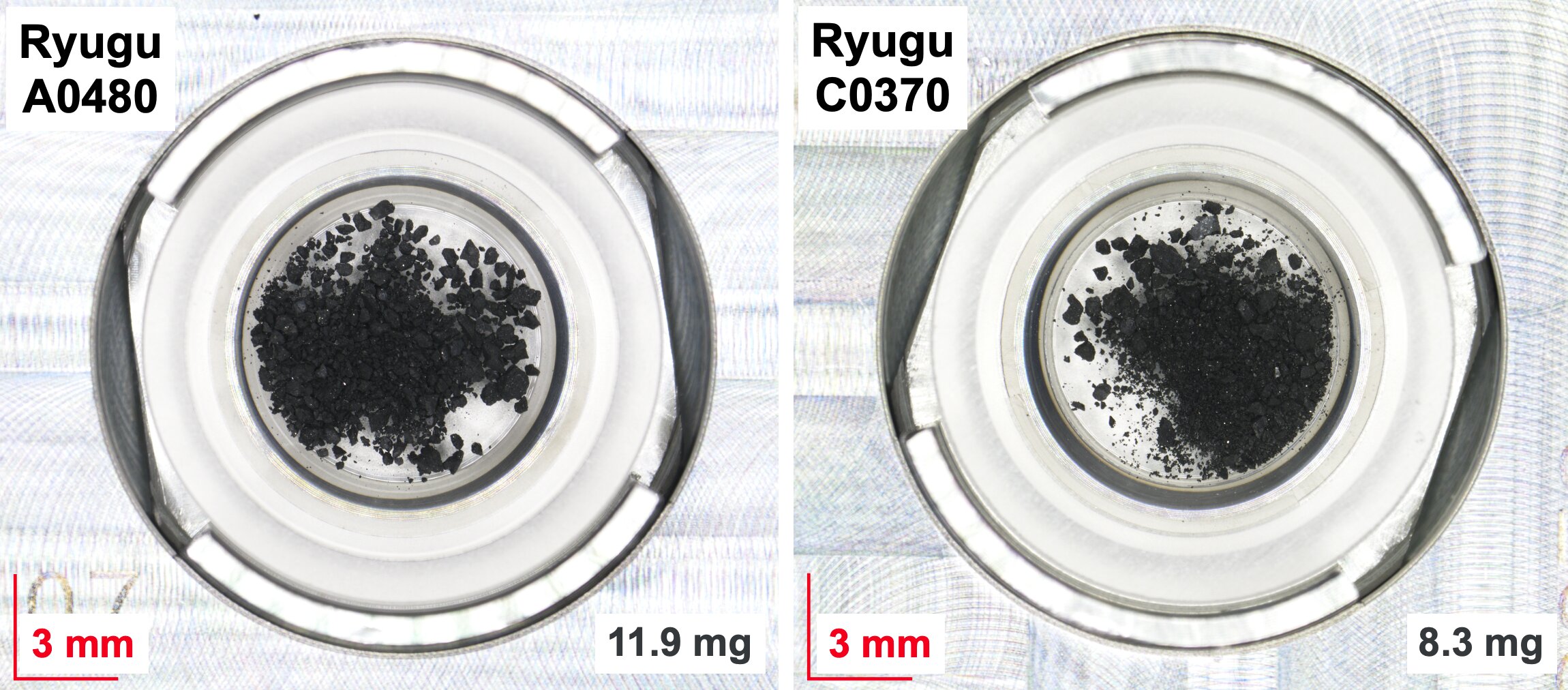
Hayabusa2 touchdown site microscope images. Credit: JAXA / JAMSTEC
VOYAGE OF THE HAYABUSA2 SPACECRAFT
The Japanese spacecraft Hayabusa-2 traveled over 300 million kilometers to reach the 900-meter-wide carbonaceous asteroid known as Ryugu. This ambitious mission launched in 2014 with the specific goal of retrieving pristine samples from the extraterrestrial surface.
The spacecraft successfully returned two distinct rock samples to Earth in 2020 weighing approximately 5.4 grams. These samples have since provided a rare opportunity for biochemists to study materials that have not been contaminated by Earth’s environment.
COMPARING RYUGU AND BENNU SAMPLES
Similar findings were recently reported from fragments of the asteroid Bennu which were brought back by NASA missions. The consistency between these two different asteroids suggests that prebiotic materials are abundant across the cosmos, reports Phys.
Scientists also compared these findings to historical data from the Murchison meteorite and the Orgueil space rocks. The varying levels of genetic components found in these specimens provide clues about the unique history of each celestial body.
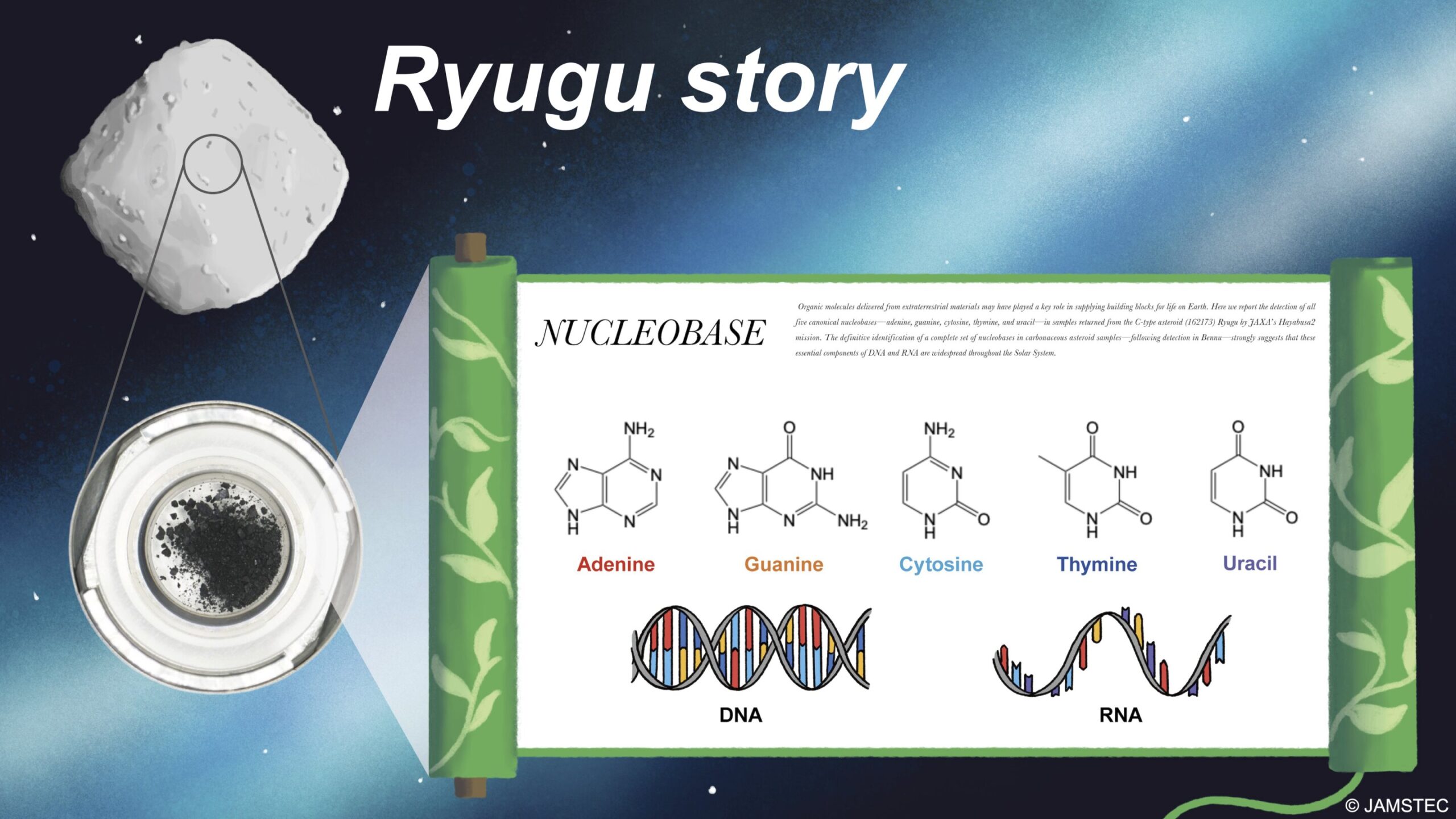
Ryugu DNA nucleobase discovery illustration. Credit: JAMSTEC
THE ROLE OF AMMONIA IN MOLECULAR FORMATION
Researchers identified a surprising correlation between the concentration of nucleobases and the presence of ammonia. This specific chemical relationship suggests a previously unknown formation pathway for life-sustaining molecules in space.
Experts believe this unique discovery could rewrite our understanding of how biologically important molecules were synthesized. It points toward a complex chemical inventory that existed during the early stages of our solar system’s development.
IMPLICATIONS FOR EARLY EARTH CHEMISTRY
While the discovery does not mean life once existed on Ryugu, it reinforces the delivery hypothesis regarding Earth’s history. This theory suggests that asteroid impacts delivered the necessary ingredients to our planet to jumpstart biological evolution.
The presence of these elements across multiple asteroids gives researchers a clear idea of what organic matter can form in space. This knowledge helps narrow down the specific prebiotic conditions that eventually led to the emergence of living organisms.

Mariana Trench: 8 Fascinating Facts About the Earth’s Deepest Place
10 most famous scientists who contributed to astronomy and space

Top 25 extremely stunning photos of Northern Lights of 2020 revealed

Meteorite makes Indonesian man a millionaire as piece crashes through his roof

It’s Now Possible to Predict Blood Cancer With Ten-Second Videos

This Inexpensive Method Speeds up Analysis of 3D Printed Metal Parts

SpaceX Dragon: A Game Changer for NASA
Tiny fish, big boom: This small fish found to roar like a gunshot

Turkish city unveils design of Mars Colony project for tourists

Researchers Reveal the Source of the Electron Rain Phenomenon

A New Study Reveals How Climate Change Will Affect Sound Travels Underwater
Here Are 6 Space Technologies We Can Benefit to Improve Life on Earth
SpaceX Announced Crew Dragon Will No Longer Be Produced
Russia Warns Sanctions on Moscow Could Endanger the ISS
A New Study Reveals How to Make Walking Easier

Remote-control cars to race on the Moon in 2021

Space Debris Problem Is Getting Worse: Causes and Removal Efforts of Rambling Junk

Microplastic Pollution Detected in Human Blood for the First Time

Nvidia CEO declares coding’s end in AI era

Here Is Blue Origin’s Touristic Rocket: The New Shepard Design
The Fastest Manned Plane in the World: Here’s The Insane Engineering of the X-15
Here Are 6 Space Technologies We Can Benefit to Improve Life on Earth
Pentagon Formed A New Group To Investigate UFO Reports
Space Debris Problem Is Getting Worse: Causes and Removal Efforts of Rambling Junk
From New Zealand to the US: The Rocket Lab Story
Here Is Blue Origin’s Touristic Rocket: The New Shepard Design

Take a Look at Earth From Space: Glasgow, Scotland

NASA Is Preparing Next Generation Spacesuits for Moon Mission and Beyond
Remote-control cars to race on the Moon in 2021
Meteorite makes Indonesian man a millionaire as piece crashes through his roof
NASA sends a new Space toilet for astronauts to ISS

 Earth & Energy5 years ago
Mariana Trench: 8 Fascinating Facts About the Earth’s Deepest Place

 Space6 years ago
10 most famous scientists who contributed to astronomy and space
- Skywatching6 years ago
Top 25 extremely stunning photos of Northern Lights of 2020 revealed
- Engineering6 years ago
Meteorite makes Indonesian man a millionaire as piece crashes through his roof

 Science5 years ago
It’s Now Possible to Predict Blood Cancer With Ten-Second Videos
 Engineering5 years ago
This Inexpensive Method Speeds up Analysis of 3D Printed Metal Parts
- Infographic6 years ago
SpaceX Dragon: A Game Changer for NASA

 Earth & Energy3 years ago
Tiny fish, big boom: This small fish found to roar like a gunshot