
Tech
It’s Announced. Fusion and Medical Device Technology Will Develop With New Magnet
It could lead to lower costs.


In an article published in Superconductor Science and Technology, scientists announced that they have designed a type of magnet that can be used in a variety of devices, from fusion plants known as tokamaks to medical machines that create detailed pictures of the human body.
Tokamaks work with a central electromagnet, known as a solenoid, to create electric currents and magnetic fields in plasma, the hot and charged state of matter made up of free electrons and atomic nuclei, resulting in infusion reactions. But over time, the insulation surrounding the wires of the electromagnet can deteriorate after exposure to various subatomic particles, reducing the tokamak’s ability to harness its fusion power.
In this new type of magnet, the metal acts as insulation and absorbs the effect of particles. It can also operate at higher temperatures than existing superconducting electromagnets.
Fusion combines light elements in the form of plasma to produce large amounts of energy. And scientists are trying to replicate fusion on Earth, an almost inexhaustible source of power to generate electricity.
“Our innovation both simplifies the fabrication process and makes the magnet more tolerant of the radiation produced by the fusion reactions,” said Yuhu Zhai, chief engineer at the US Department of Energy’s Princeton Plasma Physics Laboratory and lead author of the paper.
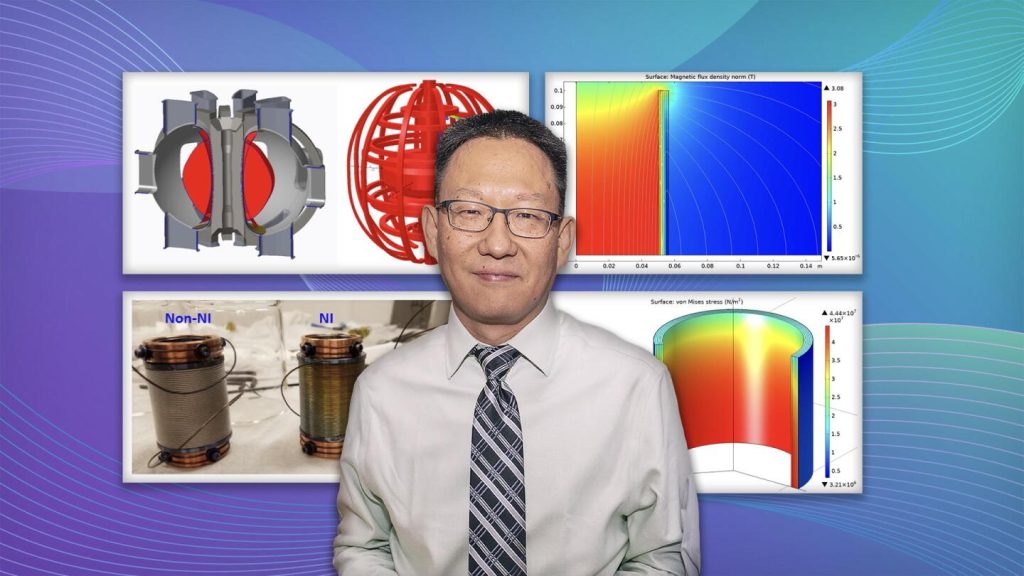
Yuhu Zhai, a principal engineer at PPPL
“If we are designing a power plant that will run continuously for hours or days, then we can’t use current magnets,” Zhai said. In these facilities, which will produce particles with higher energy than the existing experimental facilities, the magnets in production today will no longer be valid.”
An electromagnet is a magnet made from iron using an electric current. Both ends of the electromagnet attract magnetic materials. Electromagnets are used in a variety of places, from tokamaks to cranes that lift cars that break down in landfills, to magnetic resonance imaging devices that scan the inside of the human body.
“Scientists typically only use 70 percent of the superconducting wire electrical current capacity when designing and building high-power magnets,” he said. “And large-scale magnets like those used in ITER, the international fusion facility being constructed in France, often use only 50 percent”.
Details of the magnet
The magnet in question has wires made of the elements niobium and tin, which when heated in a special way form a superconductor that allows electric current to flow without resistance at extremely low temperatures. Therefore, much less insulation is needed to prevent current leakage, according to Phys.
Robert Ellis, PPPL Chief Engineer, said: “This new concept is interesting because it allows the magnet to carry a lot of electrical current in a little space, reducing the amount of volume the magnet occupies in a tokamak.”
“This magnet could also operate at higher current densities and stronger magnetic fields than magnets can today. Both qualities are important and could lead to lower costs,” Ellis added.

Mariana Trench: 8 Fascinating Facts About the Earth’s Deepest Place
10 most famous scientists who contributed to astronomy and space

Top 25 extremely stunning photos of Northern Lights of 2020 revealed

Meteorite makes Indonesian man a millionaire as piece crashes through his roof
It’s Now Possible to Predict Blood Cancer With Ten-Second Videos
This Inexpensive Method Speeds up Analysis of 3D Printed Metal Parts

SpaceX Dragon: A Game Changer for NASA
Tiny fish, big boom: This small fish found to roar like a gunshot

Turkish city unveils design of Mars Colony project for tourists

Researchers Reveal the Source of the Electron Rain Phenomenon

A New Study Reveals How Climate Change Will Affect Sound Travels Underwater

Here Are 6 Space Technologies We Can Benefit to Improve Life on Earth
SpaceX Announced Crew Dragon Will No Longer Be Produced
Russia Warns Sanctions on Moscow Could Endanger the ISS
A New Study Reveals How to Make Walking Easier

Remote-control cars to race on the Moon in 2021

Space Debris Problem Is Getting Worse: Causes and Removal Efforts of Rambling Junk
Microplastic Pollution Detected in Human Blood for the First Time

Nvidia CEO declares coding’s end in AI era

Here Is Blue Origin’s Touristic Rocket: The New Shepard Design

The Fastest Manned Plane in the World: Here’s The Insane Engineering of the X-15
Here Are 6 Space Technologies We Can Benefit to Improve Life on Earth
Pentagon Formed A New Group To Investigate UFO Reports
Space Debris Problem Is Getting Worse: Causes and Removal Efforts of Rambling Junk
From New Zealand to the US: The Rocket Lab Story
Here Is Blue Origin’s Touristic Rocket: The New Shepard Design

Take a Look at Earth From Space: Glasgow, Scotland
NASA Is Preparing Next Generation Spacesuits for Moon Mission and Beyond
Remote-control cars to race on the Moon in 2021
Meteorite makes Indonesian man a millionaire as piece crashes through his roof
NASA sends a new Space toilet for astronauts to ISS

 Earth & Energy5 years ago
Mariana Trench: 8 Fascinating Facts About the Earth’s Deepest Place

 Space6 years ago
10 most famous scientists who contributed to astronomy and space
- Skywatching6 years ago
Top 25 extremely stunning photos of Northern Lights of 2020 revealed
- Engineering6 years ago
Meteorite makes Indonesian man a millionaire as piece crashes through his roof

 Science5 years ago
It’s Now Possible to Predict Blood Cancer With Ten-Second Videos
 Engineering5 years ago
This Inexpensive Method Speeds up Analysis of 3D Printed Metal Parts
- Infographic6 years ago
SpaceX Dragon: A Game Changer for NASA

 Earth & Energy3 years ago
Tiny fish, big boom: This small fish found to roar like a gunshot