
Space
Europe’s ExoMars Rover Faces an Indefinite Delay Following Sanctions Against Russia
ESA should now look for alternatives to put the rover on the Red Planet.

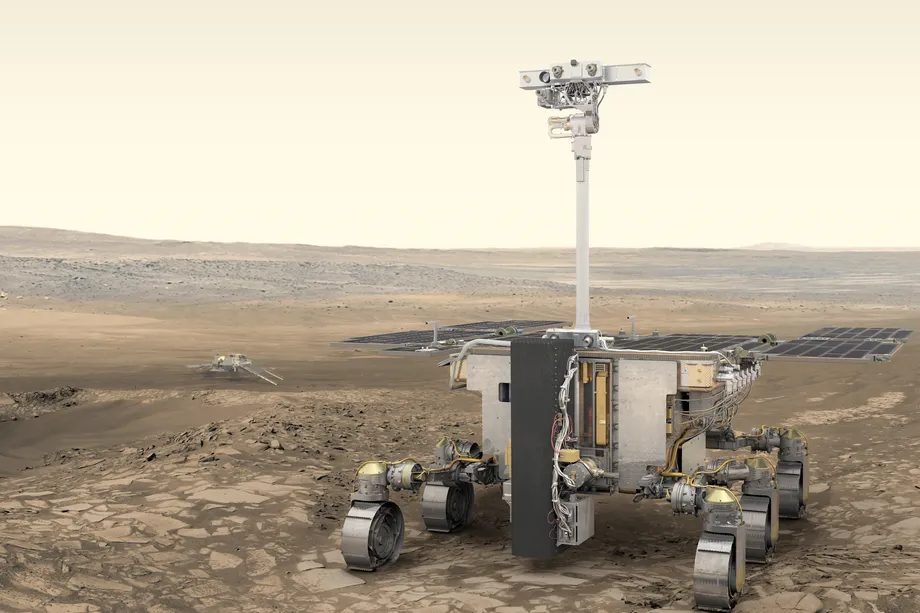
The European Space Agency (ESA) has indefinitely postponed its ExoMars program with the Russian Space Agency, Roscosmos. The dispatch of the ExoMars rover, presently known as the Rosalind Franklin rover, was supposed to launch sometime in September 2022.
The delay is the third time after it was previously scheduled for launch in 2018, but technical issues forced the launch to be pushed back to 2020. However, another issue with parachute testing occurred that year, delaying the rover’s launch by two years.
Fate again said otherwise. The tragedy of the Russian invasion of Ukraine, which began last February, disables ESA from continuing its cooperative mission with Roscosmos, which plays a critical role in the project’s delivery of the rover and surface platform to Martian soil.
A tough decision on the ExoMars program
The Rosalind Franklin rover is part of the ExoMars program that supports other Mars missions to determine whether life ever existed on this rocky red sphere. The rover will traverse the Martian surface and study its depths to collect samples for analysis in an onboard laboratory.
Russia’s participation in carrying out this mission is really quite vital, given that the program is led by ESA and Roscosmos. Russia has built the Proton rocket to carry the ExoMars payloads as well as a landing platform for the rover.
Not to mention Russian equipment and radioisotope heating units aboard the ExoMars rover. This decision on the ExoMars program is certainly hard for ESA and profoundly regretted as many years of effort have been put into the mission.
“It’s a disappointment for the people involved in the project. It was an agonizing decision for the council to make,” said the head of human and robotic exploration at ESA, David Parker, according to SpaceNews’ report.
“As an intergovernmental organisation mandated to develop and implement space programmes in full respect with European values, we deeply deplore the human casualties and tragic consequences of the aggression towards Ukraine,” ESA said in a press release. “While recognising the impact on scientific exploration of space, ESA is fully aligned with the sanctions imposed on Russia by its Member States.”
Not the end of the mission, yet
But ESA does not seem to surrender to reality. The ESA council delegated its Director-General, Josef Aschbacher, to conduct an industrial study in search of alternatives. One option is to try again with NASA. ESA took on this project alongside NASA around a decade ago, but it was eventually handed over to Roscosmos because the US space agency withdrew from the program.
As SpaceNews reported, Aschbacher said, “What we really need to do is to look into these options. The options in terms of Europe alone or Europe with other partners.” For now, according to Aschbacher, NASA has shown its willingness to support them.
However, if the situation in Europe recovers and ESA’s relationship with Roscosmos can continue as usual, it is not impossible for the two agencies to undertake this launch mission. Parker stated that with a significant reconfiguration, the launch might be feasible in 2026 or 2028.

Mariana Trench: 8 Fascinating Facts About the Earth’s Deepest Place
10 most famous scientists who contributed to astronomy and space

Top 25 extremely stunning photos of Northern Lights of 2020 revealed

Meteorite makes Indonesian man a millionaire as piece crashes through his roof
It’s Now Possible to Predict Blood Cancer With Ten-Second Videos
This Inexpensive Method Speeds up Analysis of 3D Printed Metal Parts

SpaceX Dragon: A Game Changer for NASA
Tiny fish, big boom: This small fish found to roar like a gunshot

Turkish city unveils design of Mars Colony project for tourists

Researchers Reveal the Source of the Electron Rain Phenomenon
A New Study Reveals How Climate Change Will Affect Sound Travels Underwater
Here Are 6 Space Technologies We Can Benefit to Improve Life on Earth
SpaceX Announced Crew Dragon Will No Longer Be Produced
Russia Warns Sanctions on Moscow Could Endanger the ISS
A New Study Reveals How to Make Walking Easier

Remote-control cars to race on the Moon in 2021
Space Debris Problem Is Getting Worse: Causes and Removal Efforts of Rambling Junk

Microplastic Pollution Detected in Human Blood for the First Time

Nvidia CEO declares coding’s end in AI era
Here Is Blue Origin’s Touristic Rocket: The New Shepard Design
The Fastest Manned Plane in the World: Here’s The Insane Engineering of the X-15
Here Are 6 Space Technologies We Can Benefit to Improve Life on Earth
Pentagon Formed A New Group To Investigate UFO Reports
Space Debris Problem Is Getting Worse: Causes and Removal Efforts of Rambling Junk
From New Zealand to the US: The Rocket Lab Story
Here Is Blue Origin’s Touristic Rocket: The New Shepard Design
Take a Look at Earth From Space: Glasgow, Scotland
NASA Is Preparing Next Generation Spacesuits for Moon Mission and Beyond
Remote-control cars to race on the Moon in 2021
Meteorite makes Indonesian man a millionaire as piece crashes through his roof
NASA sends a new Space toilet for astronauts to ISS

 Earth & Energy5 years ago
Mariana Trench: 8 Fascinating Facts About the Earth’s Deepest Place

 Space6 years ago
10 most famous scientists who contributed to astronomy and space
- Skywatching6 years ago
Top 25 extremely stunning photos of Northern Lights of 2020 revealed
- Engineering6 years ago
Meteorite makes Indonesian man a millionaire as piece crashes through his roof

 Science5 years ago
It’s Now Possible to Predict Blood Cancer With Ten-Second Videos
 Engineering5 years ago
This Inexpensive Method Speeds up Analysis of 3D Printed Metal Parts
- Infographic6 years ago
SpaceX Dragon: A Game Changer for NASA

 Earth & Energy3 years ago
Tiny fish, big boom: This small fish found to roar like a gunshot