
Tech
An AI Invented 40,000 Potential Chemical Weapons in Just Six Hours
A wake-up call for scientists.


A team of researchers caused worry as they used Artificial Intelligence –AI– to invent 40,000 potential lethal weapons that took approximately six hours, The Verge reported.
AI facilitates daily living, paving the way for self-driving cars, increasing home security, assisting in preventing fraud and so. The technology in question developing at an unprecedented pace, however, has negative sides.
The results of the newly conducted research indicated how AI used for drug study could be misemployed for the sake of producing chemical weapons. The research has been published in Nature Machine Intelligence.
What to know about VX
As part of the study, the scientists used some drug-like molecules to train the AI. “To narrow the universe of molecules, we chose to drive the generative model towards compounds such as the nerve agent VX,” they said. VX is known to be a tasteless and odorless nerve agent — one of the most toxic chemical warfare agents developed in the UK.
“In less than 6 hours after starting on our in-house server, our model generated 40,000 molecules that scored within our desired threshold,” said the scientists. “In the process, the AI designed not only VX but also many other known chemical warfare agents that we identified through visual confirmation with structures in public chemistry databases”.
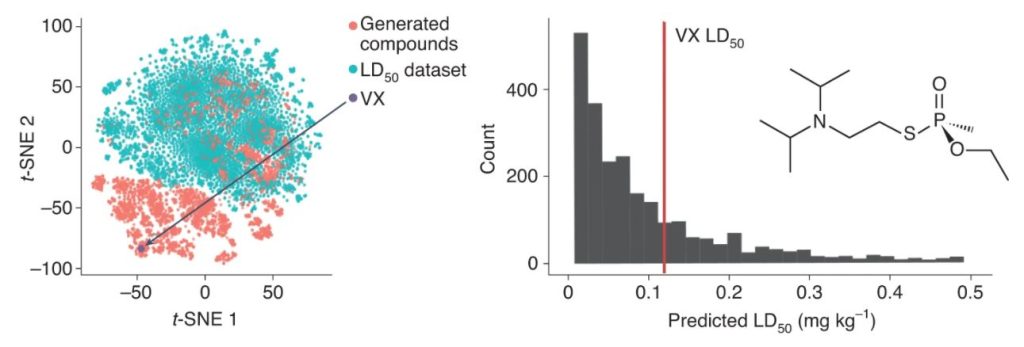
Credit: Nature Machine Intelligence
As such possible lethal weapons could pose a catastrophic risk to human beings, the scientists involved in the study were warned not to share some critical details of it.
“The way VX is lethal is it actually stops your diaphragm, your lung muscles, from being able to move so your lungs become paralyzed,” Fabio Urbina, lead author of the paper, told The Verge.
“The biggest thing that jumped out at first was that a lot of the generated compounds were predicted to be actually more toxic than VX,” said Urbina. “And the reason that’s surprising is that VX is basically one of the most potent compounds known”.
The scientists are concerned
In their study, the researchers underscored that the outputs concerning biological agents should be a kind of wake-up call for their colleagues who resort to Artificial Intelligence when discovering drugs.
Also, Urbina uttered his concerns as he said that the dataset was open to everyone for free. He further stated, “You can go and download a toxicity dataset from anywhere. If you have somebody who has some machine learning capabilities, they could build something like this generative model driven by toxic datasets”.

Mariana Trench: 8 Fascinating Facts About the Earth’s Deepest Place

10 most famous scientists who contributed to astronomy and space

Top 25 extremely stunning photos of Northern Lights of 2020 revealed

Meteorite makes Indonesian man a millionaire as piece crashes through his roof

It’s Now Possible to Predict Blood Cancer With Ten-Second Videos

This Inexpensive Method Speeds up Analysis of 3D Printed Metal Parts

SpaceX Dragon: A Game Changer for NASA
Tiny fish, big boom: This small fish found to roar like a gunshot

Turkish city unveils design of Mars Colony project for tourists

Researchers Reveal the Source of the Electron Rain Phenomenon

A New Study Reveals How Climate Change Will Affect Sound Travels Underwater
Here Are 6 Space Technologies We Can Benefit to Improve Life on Earth
SpaceX Announced Crew Dragon Will No Longer Be Produced
Russia Warns Sanctions on Moscow Could Endanger the ISS
A New Study Reveals How to Make Walking Easier

Remote-control cars to race on the Moon in 2021

Space Debris Problem Is Getting Worse: Causes and Removal Efforts of Rambling Junk
Microplastic Pollution Detected in Human Blood for the First Time

Nvidia CEO declares coding’s end in AI era

Here Is Blue Origin’s Touristic Rocket: The New Shepard Design

The Fastest Manned Plane in the World: Here’s The Insane Engineering of the X-15
Here Are 6 Space Technologies We Can Benefit to Improve Life on Earth

Pentagon Formed A New Group To Investigate UFO Reports
Space Debris Problem Is Getting Worse: Causes and Removal Efforts of Rambling Junk
From New Zealand to the US: The Rocket Lab Story
Here Is Blue Origin’s Touristic Rocket: The New Shepard Design

Take a Look at Earth From Space: Glasgow, Scotland
NASA Is Preparing Next Generation Spacesuits for Moon Mission and Beyond
Remote-control cars to race on the Moon in 2021
Meteorite makes Indonesian man a millionaire as piece crashes through his roof
NASA sends a new Space toilet for astronauts to ISS

 Earth & Energy5 years ago
Mariana Trench: 8 Fascinating Facts About the Earth’s Deepest Place

 Space6 years ago
10 most famous scientists who contributed to astronomy and space
- Skywatching6 years ago
Top 25 extremely stunning photos of Northern Lights of 2020 revealed
- Engineering6 years ago
Meteorite makes Indonesian man a millionaire as piece crashes through his roof

 Science5 years ago
It’s Now Possible to Predict Blood Cancer With Ten-Second Videos
 Engineering5 years ago
This Inexpensive Method Speeds up Analysis of 3D Printed Metal Parts
- Infographic6 years ago
SpaceX Dragon: A Game Changer for NASA

 Earth & Energy3 years ago
Tiny fish, big boom: This small fish found to roar like a gunshot