
Tech
Morphing Polymer Technology: Bone-Growth Inspired Material Revealed
A potential step in bioengineering with morphing polymers.

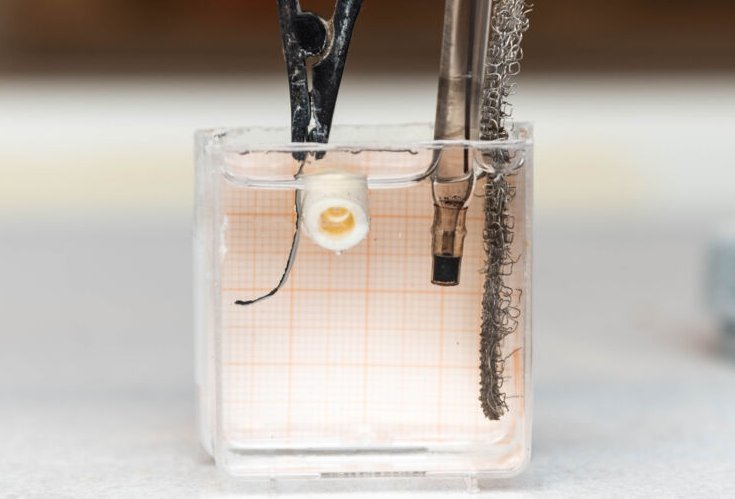
Stiffness, defining how tough material is under certain forces, is an important quality in most materials including polymers. As most engineers dream of a material that can morph into any shape, be soft or stiff when it is required; this development may reveal a way to achieve that dream. Recently, researchers from Linköping University in Sweden and Okayama University in Japan have developed an electroactive polymer, a “biohybrid variable-stiffness soft actuator” in their terms, that can stay like a gel until a low voltage is applied. Their findings were later published with the title “Biohybrid Variable-Stiffness Soft Actuators that Self-Create Bone“.
How does the new polymer work?
As the researchers claim, it is very much like an electrically stimulated micro-robot. It can change shapes, or toughen at the desired time. According to the research, the material uses an electroactive polymer that can be stimulated by electricity inside an “alginate hydrogels functionalized with cell-derived plasma membrane nanofragments (PMNFs) as the bioinducing source for mineralization and stiffening of the gel layer”. These membrane fragments are from special cells that take part in our bone development. The final material stays like a gel, bends into shape in hard-to-adapt environments, and then hardens to support the structure.
The main gimmick of the technology is to replicate the process of bone hardening. It is like how a baby’s skull is soft tissue while being born, mineralizing and hardening after years. As there are still issues with controlling the thickness and some qualities of the materials, it is very promising research especially when looking at the possible medical applications and can save lives when it is completed.
Credit: Pexels
Possible use cases
With developments around material quality and strength, it may be used in surgical operations on bones that are fragmented, to go in between and fit as perfect support. Especially with robotic surgeries, it might be like a 3D printer material for complex operations on the human body if it is developed to its perfected state. In the end, robotic surgeries are far more advanced than ever if you remember my previous article “A Robot Performs First Surgery on Soft Tissue Without Human Help“. Other than that, the researchers also state:
PMNF-based biohybrid materials could be used in new tools for tissue engineering, including robot-assisted surgical interventions, such as morphing bioadhesives, to adhere (electronic) components to bone, or to create a hard protective shell around such electronic components that integrates into the body.
Meaning that the technology can also be used as a natural protection for electronic or foreign components inside the body. A bioadhesive that can create protective shells in between tissues would be a really interesting concept as well. The research surely has a lot of potential in terms of bioengineering.
References: , , , , Biohybrid Variable-Stiffness Soft Actuators that Self-Create Bone. Adv. Mater. 2022, 2107345. https://doi.org/10.1002/adma.202107345

Mariana Trench: 8 Fascinating Facts About the Earth’s Deepest Place
10 most famous scientists who contributed to astronomy and space

Top 25 extremely stunning photos of Northern Lights of 2020 revealed

Meteorite makes Indonesian man a millionaire as piece crashes through his roof
It’s Now Possible to Predict Blood Cancer With Ten-Second Videos
This Inexpensive Method Speeds up Analysis of 3D Printed Metal Parts

SpaceX Dragon: A Game Changer for NASA
Tiny fish, big boom: This small fish found to roar like a gunshot

Turkish city unveils design of Mars Colony project for tourists

Researchers Reveal the Source of the Electron Rain Phenomenon

A New Study Reveals How Climate Change Will Affect Sound Travels Underwater

Here Are 6 Space Technologies We Can Benefit to Improve Life on Earth

SpaceX Announced Crew Dragon Will No Longer Be Produced

Russia Warns Sanctions on Moscow Could Endanger the ISS
A New Study Reveals How to Make Walking Easier

Remote-control cars to race on the Moon in 2021

Space Debris Problem Is Getting Worse: Causes and Removal Efforts of Rambling Junk
Microplastic Pollution Detected in Human Blood for the First Time

Nvidia CEO declares coding’s end in AI era

Here Is Blue Origin’s Touristic Rocket: The New Shepard Design

The Fastest Manned Plane in the World: Here’s The Insane Engineering of the X-15
Here Are 6 Space Technologies We Can Benefit to Improve Life on Earth

Pentagon Formed A New Group To Investigate UFO Reports
Space Debris Problem Is Getting Worse: Causes and Removal Efforts of Rambling Junk
From New Zealand to the US: The Rocket Lab Story
Here Is Blue Origin’s Touristic Rocket: The New Shepard Design

Take a Look at Earth From Space: Glasgow, Scotland

NASA Is Preparing Next Generation Spacesuits for Moon Mission and Beyond
Remote-control cars to race on the Moon in 2021
Meteorite makes Indonesian man a millionaire as piece crashes through his roof
NASA sends a new Space toilet for astronauts to ISS

 Earth & Energy5 years ago
Mariana Trench: 8 Fascinating Facts About the Earth’s Deepest Place

 Space6 years ago
10 most famous scientists who contributed to astronomy and space
- Skywatching6 years ago
Top 25 extremely stunning photos of Northern Lights of 2020 revealed
- Engineering6 years ago
Meteorite makes Indonesian man a millionaire as piece crashes through his roof

 Science5 years ago
It’s Now Possible to Predict Blood Cancer With Ten-Second Videos
 Engineering5 years ago
This Inexpensive Method Speeds up Analysis of 3D Printed Metal Parts
- Infographic6 years ago
SpaceX Dragon: A Game Changer for NASA

 Earth & Energy3 years ago
Tiny fish, big boom: This small fish found to roar like a gunshot