
Space
Meet 2021 PH27, the Fastest Asteroid Found in the Solar System
The second fastest celestial object to orbit the sun.

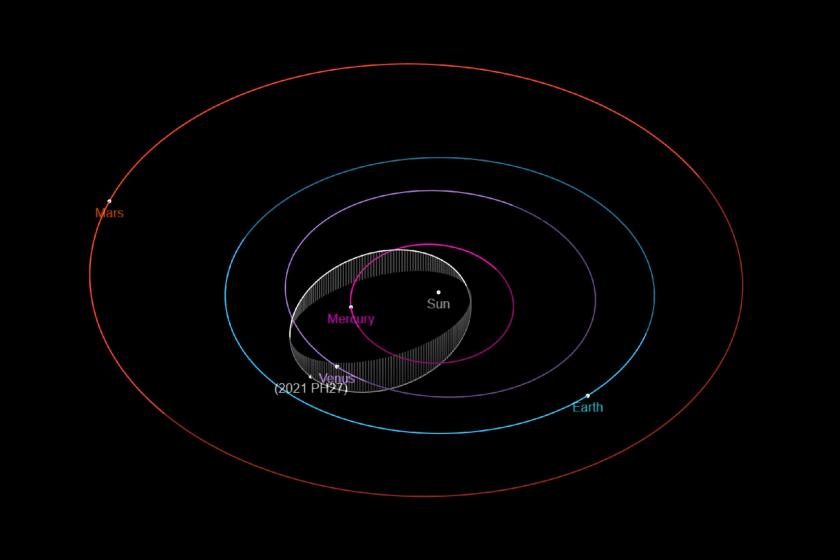
The fastest-moving asteroid named 2021 PH27 was discovered back in August 2021. An American astronomer, Scott Sheppard, found it utilizing Dark Energy Camera (DEC), a multi-purpose instrument that can capture images of objects in the cosmos at multiple frequencies.
This new-discovered asteroid circles around the sun every 113 earth days, and it is the quickest orbital period of any astronomical objects after Mercury, which takes 88 days to complete a lap around the sun.
The characteristics of 2021 PH27 Asteroid
Sheppard and his team estimated the asteroid is 1 km in size, with an absolute brightness scale of 17.73, reflecting 15 percent of the light it gets from the sun. Despite its size, this asteroid is not in the category of a Potential Hazardous Object/PHO because its Minimum Orbit Intersection Distance/MOID, when measured from the earth, is much higher than MOID for PHO.
The space rock might have started off in the main asteroid belt between Mars and Jupiter, before being pushed inside by gravitational interactions with one or more planets.
The temperature of 2021 PH27 asteroid reaches 500 degrees Celsius when it comes near the sun. Due to its capacity to approach the closest point to the sun, 2021 PH27 has the biggest general relativity effect of any other space objects.
As a result of such effect, Sheppard’s team discovered a slight shake in the elliptical orbit of 2021 PH27. The team stated that if the asteroid is not expelled off its path by a gravitational interaction, it will crash the sun, Mercury, or Venus in a few million years.
In addition to having a shorter orbital period than Mercury, the 2021 PH27 orbit is also more elliptical. It is nearly 3,5 times more elliptical than Mercury’s orbit.

Image credit: CTIO/NOIRLab/NSF/DOE/DECam/AURA/S.S. Sheppard (Carnegie Institution of Science)
The status of 2021 PH27 Asteroid
According to Andi Pangerang, a researcher at Indonesia’s Institute of Aeronautics and Space, 2021 PH27 would pass safely close to the earth on May 20, 2024, May 8, 2025, April 28, 2026, and May 1, 2031, with the closest distance of 37 million kilometers.
The information was provided based on data from NASA regarding the astronomical database of small objects in the solar system, or SBDB (Small Body Database). This asteroid will also pass close to Venus in 2022 on March 7 and October 26, June 7, 2023, and January 18, 2024, according to the data.
The orbital path of this asteroid is 32 degrees inclined relative to the plane of the solar system.
As reported by space.com, “Such a high inclination suggests it might instead be an extinct comet that was born in the far outer solar system, then captured into a closer orbit after passing by Mars, Earth or another rocky planet.”
To answer this enigma, Sheppard and the other astronomers need to do more observations, which means they have to wait for a few months longer to obtain more data. This second-fastest asteroid is currently moving behind the sun from our viewpoint and will not reappear until early 2022.

Mariana Trench: 8 Fascinating Facts About the Earth’s Deepest Place
10 most famous scientists who contributed to astronomy and space

Top 25 extremely stunning photos of Northern Lights of 2020 revealed

Meteorite makes Indonesian man a millionaire as piece crashes through his roof
It’s Now Possible to Predict Blood Cancer With Ten-Second Videos

This Inexpensive Method Speeds up Analysis of 3D Printed Metal Parts

SpaceX Dragon: A Game Changer for NASA
Tiny fish, big boom: This small fish found to roar like a gunshot

Turkish city unveils design of Mars Colony project for tourists

Researchers Reveal the Source of the Electron Rain Phenomenon

A New Study Reveals How Climate Change Will Affect Sound Travels Underwater
Here Are 6 Space Technologies We Can Benefit to Improve Life on Earth

SpaceX Announced Crew Dragon Will No Longer Be Produced
Russia Warns Sanctions on Moscow Could Endanger the ISS

A New Study Reveals How to Make Walking Easier

Remote-control cars to race on the Moon in 2021

Space Debris Problem Is Getting Worse: Causes and Removal Efforts of Rambling Junk

Microplastic Pollution Detected in Human Blood for the First Time

Nvidia CEO declares coding’s end in AI era

Here Is Blue Origin’s Touristic Rocket: The New Shepard Design

The Fastest Manned Plane in the World: Here’s The Insane Engineering of the X-15
Here Are 6 Space Technologies We Can Benefit to Improve Life on Earth
Pentagon Formed A New Group To Investigate UFO Reports
Space Debris Problem Is Getting Worse: Causes and Removal Efforts of Rambling Junk
From New Zealand to the US: The Rocket Lab Story
Here Is Blue Origin’s Touristic Rocket: The New Shepard Design

Take a Look at Earth From Space: Glasgow, Scotland

NASA Is Preparing Next Generation Spacesuits for Moon Mission and Beyond
Remote-control cars to race on the Moon in 2021
Meteorite makes Indonesian man a millionaire as piece crashes through his roof
NASA sends a new Space toilet for astronauts to ISS

 Earth & Energy5 years ago
Mariana Trench: 8 Fascinating Facts About the Earth’s Deepest Place

 Space6 years ago
10 most famous scientists who contributed to astronomy and space
- Skywatching6 years ago
Top 25 extremely stunning photos of Northern Lights of 2020 revealed
- Engineering6 years ago
Meteorite makes Indonesian man a millionaire as piece crashes through his roof

 Science5 years ago
It’s Now Possible to Predict Blood Cancer With Ten-Second Videos
 Engineering5 years ago
This Inexpensive Method Speeds up Analysis of 3D Printed Metal Parts
- Infographic6 years ago
SpaceX Dragon: A Game Changer for NASA

 Earth & Energy3 years ago
Tiny fish, big boom: This small fish found to roar like a gunshot