
Space
Roman Space Telescope: Here’s the Next Generation of Space Observatory
The sharp-eyed cousin of Hubble.

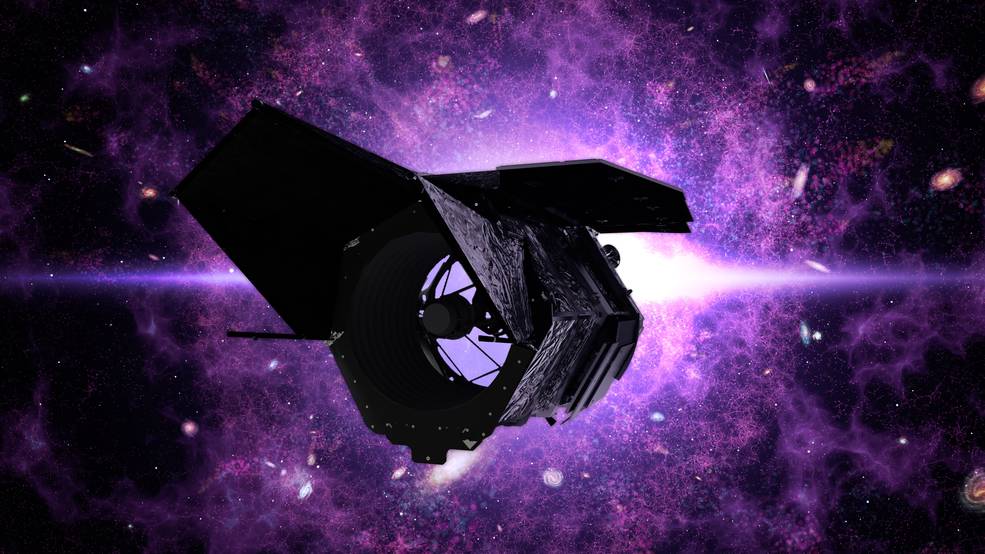
Since its launch in late December, the James Webb Space Telescope has been in the spotlight. But it seems like NASA is consistently working on development to support our better understanding of planets in space, the Solar System, and beyond. Slated to launch in 2027, the Nancy Grace Roman Space Telescope, or in short, known as the Roman Space Telescope, will function to observe more about dark matter and exoplanets.
Roman, formerly known as the Wide Field Infrared Space Telescope (WFIRST), was renamed in 2020 after NASA’s first chief astronomer, Nancy Grace Roman. What’s special about this next-generation observatory is that it has a 300-megapixel Wide Field Instrument, which allows Roman to significantly capture many times wider sky region. With sensitivity on par with Hubble, a Roman Space Telescope image will offer a broader view of the cosmological landscape.
The components that bolster the Roman Space Telescope
The Roman Space Telescope will be equipped with two main instruments. The first instrument is a 300-megapixel multi-band visible and near-infrared Wide Field camera. The second one is a high-contrast, small-field-of-view camera for coronagraphic devices with visible and near-infrared wavelength coverage.
Roman’s Wide-Field camera is special because it will record the same level of resolution as Hubble’s but across a far broader area. Meanwhile, the coronagraph works by blocking the light from exoplanets’ host stars, as exoplanets tend to be dimmer than their host stars. So, the instrument will help in the direct detection of exoplanets.
Simulation of how Roman may broaden Hubble’s vision
A group of astrophysicists ran a simulation to see how the images from the Roman Space Telescope may serve a mega exposure just as well but considerably broader than Hubble’s Ultra Deep Field images. As seen by Hubble’s Ultra Deep Field camera, the seemingly empty, endless sky was actually packed with hundreds of galaxies, each harboring millions of stars.
The team utilized a long exposure time with the Hubble Space Telescope, ranging from 2002 to 2012, allowing it to acquire more light for hundreds of hours in a single, short observation. The result enabled them to go back in time to see what it was like more than 13 billion years ago. Hubble’s Ultra Deep Field provides an excellent perspective of the early cosmos. However, it is relatively limited, covering less than one ten-millionth of the whole sky.
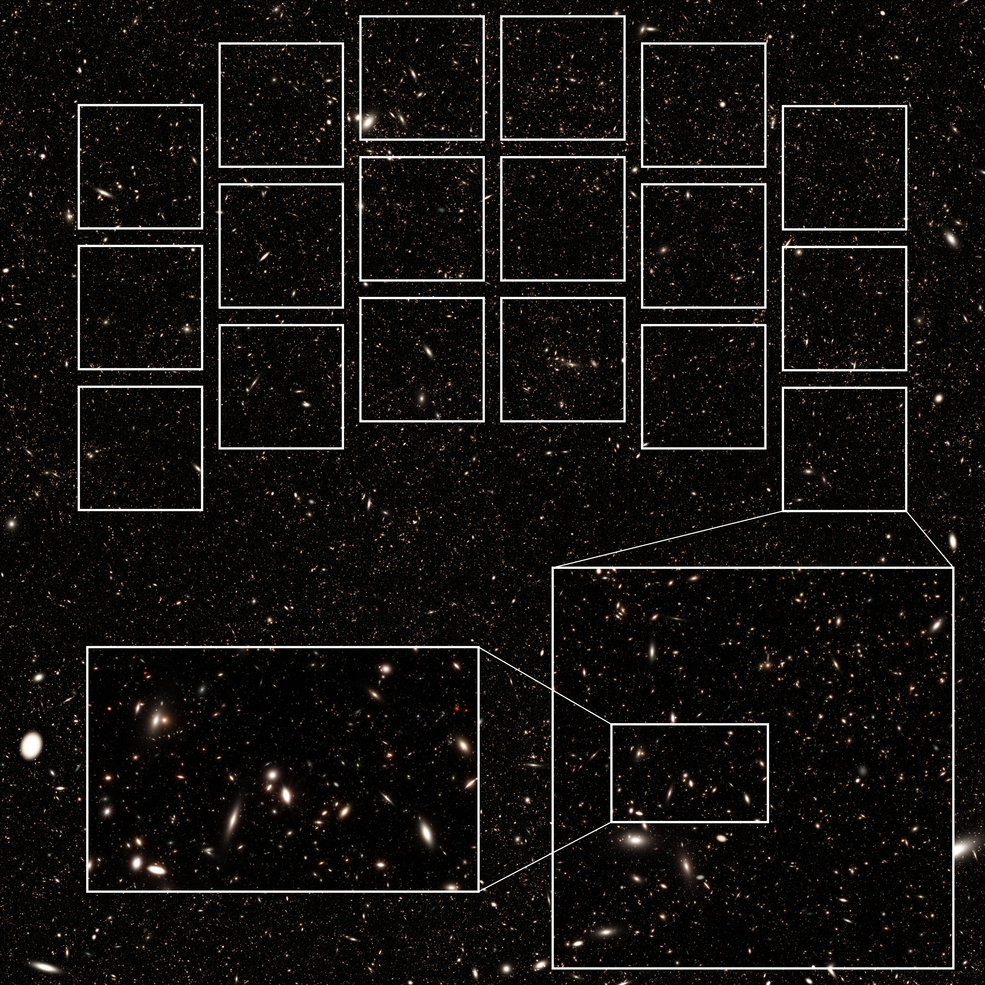
Credit: Nicole Drakos, Bruno Villasenor, Brant Robertson, Ryan Hausen, Mark Dickinson, Henry Ferguson, Steven Furlanetto, Jenny Greene, Piero Madau, Alice Shapley, Daniel Stark, Risa Wechsler
The simulation then demonstrated that Roman could go beyond what Hubble was capable of in terms of view coverage. Since the Roman Ultra Deep Field will be as strong as Hubble, it will present an identical resolution and travel back in time as far as Hubble can. But, owing to its ability to cover a 300-fold broader cosmic area, Roman is capable of displaying millions rather than hundreds of galaxies.
“It’s like looking at a single piece of a 10,000-piece puzzle. Roman could give us 100 connected puzzle pieces, offering a much better picture of what the early universe was like and opening up new scientific opportunities,” said the co-author of the study, Brant Robertson, as reported by NASA.
The study’s lead author, Nicole Drakos, said, “Roman has the unique ability to image very large areas of the sky, which allows us to see the environments around galaxies in the early universe.” Drakos, a postdoctoral fellow from the University of California, Santa Cruz, stated that their study helped highlight what a Roman ultra-deep field could reveal about the universe, while also giving scientists a tool to get the most out of such a program.
Roman in tracking down the dark ages
The wider view of Roman’s mission will generate unseen pictures of the universe that will assist astronomers to find out the unsolved mysteries across infinity. One of them is the acceleration of the universe’s expansion. One of the possible causes lies in the mysterious pressure known as dark energy, which makes up about 68% of the universe’s total energy content.
The “dark ages” were defined by the phenomenon of reionization, which occurred when the cosmos was loaded with a hot sea of plasma (ions) that created a thick, ionized fluid. When the universe cooled, the ions bonded to create hydrogen atoms, resulting in hydrogen fogs. These fogs blocked the short wavelengths of light produced by young galaxies.
The hydrogen atoms then disintegrated, reverting to energetic ions during the reionization phase. The fog cleared, revealing what had previously been dark into a dazzling night sky. The Roman Ultra Deep Field may help scientists better grasp the reionization phase by displaying wide pictures of over ten thousand galaxies as well as their surroundings in comprehensive outlooks from the dark ages.
The Roman Space Telescope will study the distribution of matter and measure the expansion of the universe using a 2.4-meter mirror similar to Hubble’s and a Wide Field Instrument. Roman will accomplish this by observing supernovae and galaxy clusters, then tracing out the distribution of galaxies in 3D. The telescope will also measure the distance to the galaxy clusters to see how they have grown through time. The observation of redshift events is also used to calculate the distances of millions of other galaxies; the more distant the galaxy, the redder the light looks.
The official website of the Roman Space Telescope mentioned, “Mapping out the 3-D positions of galaxies will allow astronomers to measure how the distribution of galaxies has changed over time, providing another measure of how dark energy has affected the cosmos.”
The Roman Space Telescope will introduce a revolutionary technology that will serve to solve the secrets of the cosmos via its huge picture and significantly contribute to the astrophysics field. What amazing discoveries there will be from the collaboration of the telescopes in orbit once Roman is aboard!

Mariana Trench: 8 Fascinating Facts About the Earth’s Deepest Place
10 most famous scientists who contributed to astronomy and space
Top 25 extremely stunning photos of Northern Lights of 2020 revealed

Meteorite makes Indonesian man a millionaire as piece crashes through his roof
It’s Now Possible to Predict Blood Cancer With Ten-Second Videos
This Inexpensive Method Speeds up Analysis of 3D Printed Metal Parts

SpaceX Dragon: A Game Changer for NASA
Tiny fish, big boom: This small fish found to roar like a gunshot

Turkish city unveils design of Mars Colony project for tourists

Researchers Reveal the Source of the Electron Rain Phenomenon

A New Study Reveals How Climate Change Will Affect Sound Travels Underwater
Here Are 6 Space Technologies We Can Benefit to Improve Life on Earth
SpaceX Announced Crew Dragon Will No Longer Be Produced
Russia Warns Sanctions on Moscow Could Endanger the ISS
A New Study Reveals How to Make Walking Easier

Remote-control cars to race on the Moon in 2021
Space Debris Problem Is Getting Worse: Causes and Removal Efforts of Rambling Junk

Microplastic Pollution Detected in Human Blood for the First Time
Nvidia CEO declares coding’s end in AI era
Here Is Blue Origin’s Touristic Rocket: The New Shepard Design
The Fastest Manned Plane in the World: Here’s The Insane Engineering of the X-15
Here Are 6 Space Technologies We Can Benefit to Improve Life on Earth
Pentagon Formed A New Group To Investigate UFO Reports
Space Debris Problem Is Getting Worse: Causes and Removal Efforts of Rambling Junk
From New Zealand to the US: The Rocket Lab Story
Here Is Blue Origin’s Touristic Rocket: The New Shepard Design
Take a Look at Earth From Space: Glasgow, Scotland
NASA Is Preparing Next Generation Spacesuits for Moon Mission and Beyond
Remote-control cars to race on the Moon in 2021
Meteorite makes Indonesian man a millionaire as piece crashes through his roof
NASA sends a new Space toilet for astronauts to ISS

 Earth & Energy5 years ago
Mariana Trench: 8 Fascinating Facts About the Earth’s Deepest Place

 Space6 years ago
10 most famous scientists who contributed to astronomy and space
- Skywatching6 years ago
Top 25 extremely stunning photos of Northern Lights of 2020 revealed
- Engineering6 years ago
Meteorite makes Indonesian man a millionaire as piece crashes through his roof

 Science5 years ago
It’s Now Possible to Predict Blood Cancer With Ten-Second Videos
 Engineering5 years ago
This Inexpensive Method Speeds up Analysis of 3D Printed Metal Parts
- Infographic6 years ago
SpaceX Dragon: A Game Changer for NASA

 Earth & Energy3 years ago
Tiny fish, big boom: This small fish found to roar like a gunshot