
Space
NASA Telescope Identified the First Planet Candidate Outside Our Galaxy
Could there be another world beyond our galaxy?

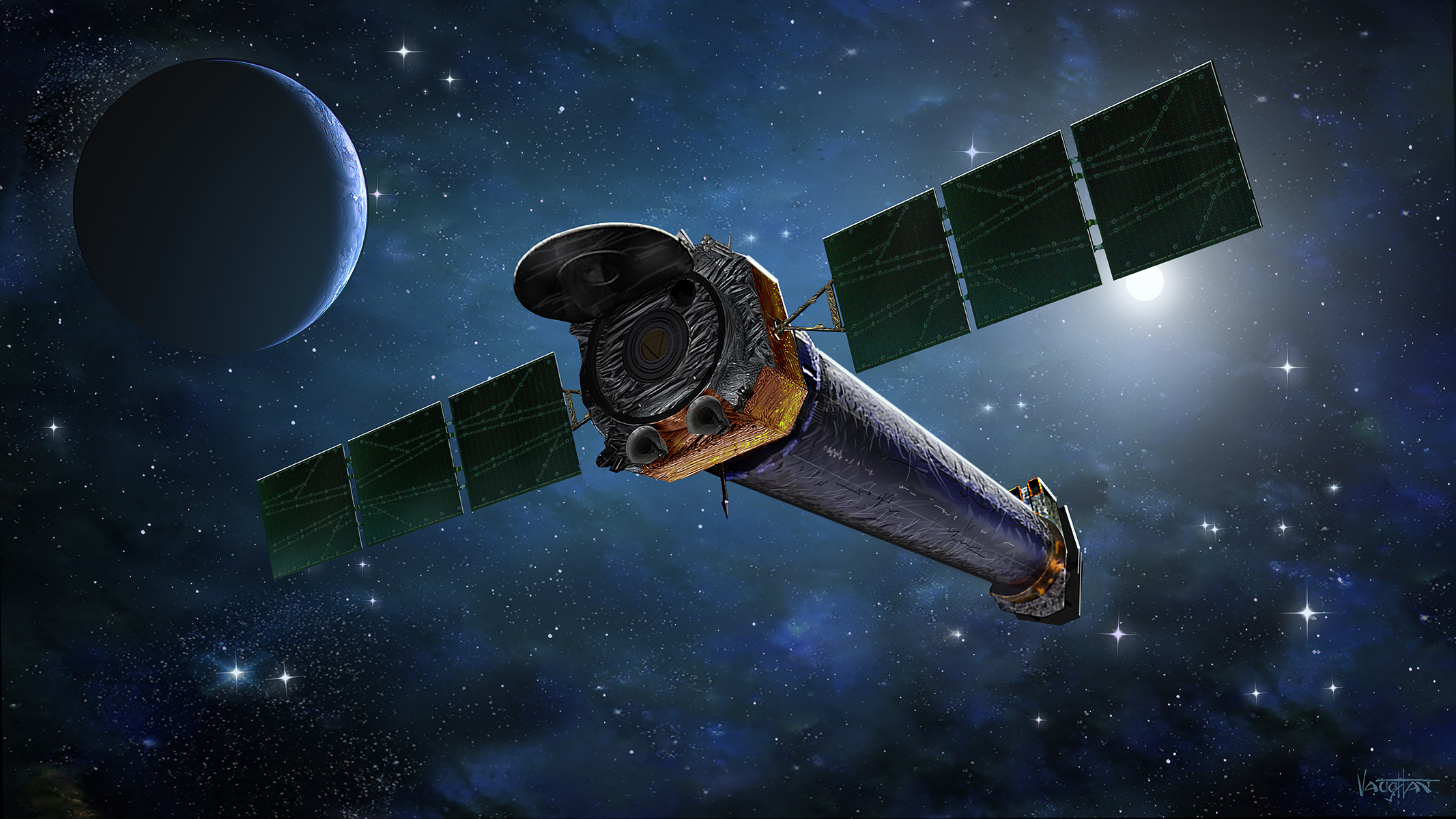
The first evidence of an extrasolar planet outside the Milky Way may have been discovered using NASA’s Chandra X-ray Observatory. An extrasolar planet, also called an exoplanet, refers to a planet beyond the Solar System that orbits a star other than the sun in the Milky Way Galaxy.
This first-ever finding opens the door to future discoveries of extrasolar planets at much greater distances. So far, astronomers have discovered thousands of extrasolar planets and their candidates, and almost all of them are less than 3,000 light-years from Earth, implying that they are all within our galaxy.
X-ray method detected the extrasolar planet outside the Milky Way
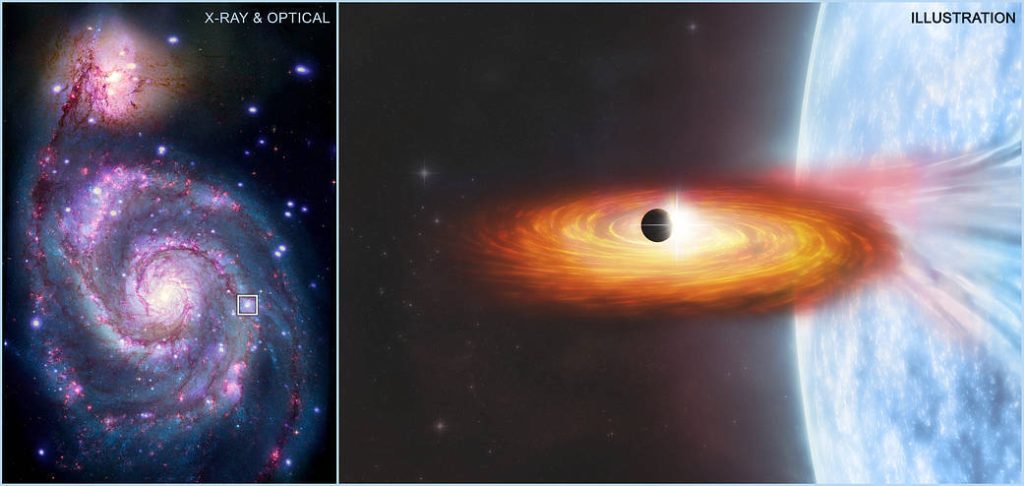
The astronomers found the possible planet in the spiral galaxy Messier 51 (M51), or known as the Whirlpool Galaxy. As reported by NASA, “An exoplanet in M51 would be about 28 million light-years away, meaning it would be thousands of times farther away than those in the Milky Way.”
The detection of an extrasolar planet is marked by a transit, in which the planet moves in front of a star, blocking part of the star’s light and causing a distinctive fall in brightness or dips in the star’s light output.
NASA
Astronomers have used ground-based and space-based telescopes for the discovery of thousands of planets. They looked for the dips of the star in optical light, electromagnetic radiation. Rosanne Di Stefano, an astrophysicist of Harvard & Smithsonian, and her colleagues have attempted a different approach.
They rely on the dips present in the X-ray light received from X-ray bright binaries. These luminous binaries consist of a neutron star or a black hole absorbing gas from a companion star in close orbit. The materials around the neutron star or black hole heat up that they shine in X-rays.
When a planet traverses the X-ray zone, the transit will be more visible because it will cover most, if not all, of the X-rays since the area that produces X-rays is small. It will be easier than the existing approach, which uses optical light to detect minor drops in light since the planet only covers a small part of the star.
[irp posts=”2071″ name=”9 Things to Know About NASA’s Lucy Mission Heading Towards Trojan Asteroids”]
Stefano’s team used the X-ray method in identifying the extrasolar planet candidate in M51. “We are trying to open up a whole new arena for finding other worlds by searching for planet candidates at X-ray wavelengths, a strategy that makes it possible to discover them in other galaxies,” said Stefano as quoted in NASA’s Exoplanet Exploration.
The candidate of the planet outside the Milky Way is estimated to be around the size of Saturn, circling the neutron star or black hole at roughly twice the distance of Saturn orbits the sun.
Confirmation of extragalactic planets requires another transit
The discovery of an extrasolar planet outside the Milky Way may be alluring. However, researchers will need to wait for a very long time to determine if they really have found an extragalactic exoplanet. Besides requiring more data to verify, the challenge is that the orbits of the exoplanet candidate are large.
The planet candidate will not pass in front of its binary companion for about 70 years, so it will take decades to confirm the existence of exoplanets outside our galaxy. If there is actually a planet in this orbit, it may have survived a supernova explosion that resulted in the neutron star.
But it also means a danger for the future, as the companion star may eventually explode as a supernova, destroying the planet with an extreme radiation.
[irp posts=”2073″ name=”Death in Space: Here Is What Would Happen to Our Body When We Die in Final Frontier”]

Mariana Trench: 8 Fascinating Facts About the Earth’s Deepest Place
10 most famous scientists who contributed to astronomy and space

Top 25 extremely stunning photos of Northern Lights of 2020 revealed

Meteorite makes Indonesian man a millionaire as piece crashes through his roof

It’s Now Possible to Predict Blood Cancer With Ten-Second Videos
This Inexpensive Method Speeds up Analysis of 3D Printed Metal Parts

SpaceX Dragon: A Game Changer for NASA
Tiny fish, big boom: This small fish found to roar like a gunshot

Turkish city unveils design of Mars Colony project for tourists

Researchers Reveal the Source of the Electron Rain Phenomenon

A New Study Reveals How Climate Change Will Affect Sound Travels Underwater
Here Are 6 Space Technologies We Can Benefit to Improve Life on Earth
SpaceX Announced Crew Dragon Will No Longer Be Produced
Russia Warns Sanctions on Moscow Could Endanger the ISS
A New Study Reveals How to Make Walking Easier

Remote-control cars to race on the Moon in 2021
Space Debris Problem Is Getting Worse: Causes and Removal Efforts of Rambling Junk

Microplastic Pollution Detected in Human Blood for the First Time

Nvidia CEO declares coding’s end in AI era
Here Is Blue Origin’s Touristic Rocket: The New Shepard Design

The Fastest Manned Plane in the World: Here’s The Insane Engineering of the X-15
Here Are 6 Space Technologies We Can Benefit to Improve Life on Earth
Pentagon Formed A New Group To Investigate UFO Reports
Space Debris Problem Is Getting Worse: Causes and Removal Efforts of Rambling Junk
From New Zealand to the US: The Rocket Lab Story
Here Is Blue Origin’s Touristic Rocket: The New Shepard Design

Take a Look at Earth From Space: Glasgow, Scotland

NASA Is Preparing Next Generation Spacesuits for Moon Mission and Beyond
Remote-control cars to race on the Moon in 2021
Meteorite makes Indonesian man a millionaire as piece crashes through his roof
NASA sends a new Space toilet for astronauts to ISS

 Earth & Energy5 years ago
Mariana Trench: 8 Fascinating Facts About the Earth’s Deepest Place

 Space6 years ago
10 most famous scientists who contributed to astronomy and space
- Skywatching6 years ago
Top 25 extremely stunning photos of Northern Lights of 2020 revealed
- Engineering6 years ago
Meteorite makes Indonesian man a millionaire as piece crashes through his roof

 Science5 years ago
It’s Now Possible to Predict Blood Cancer With Ten-Second Videos
 Engineering5 years ago
This Inexpensive Method Speeds up Analysis of 3D Printed Metal Parts
- Infographic6 years ago
SpaceX Dragon: A Game Changer for NASA

 Earth & Energy3 years ago
Tiny fish, big boom: This small fish found to roar like a gunshot