
Space
9 Things to Know About NASA’s Lucy Mission Heading Towards Trojan Asteroids
A deep dive into the uncrewed spacecraft.

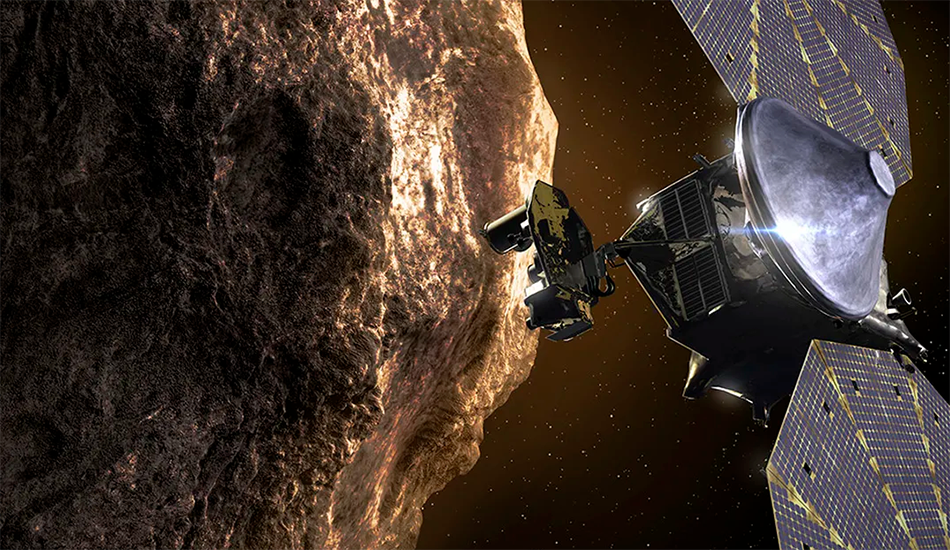
An asteroid hunter, called Lucy, was successfully launched aboard a United Launch Alliance Atlas V rocket on October 16 on a 12-year mission to study Jupiter’s asteroid swarms. The spacecraft has successfully conducted some maneuvers, and things of its systems are on track, according to the latest update by NASA regarding the Lucy mission.
Here’s what to know about the Lucy spacecraft and its target Trojan asteroid.
1- Why do scientists choose the Trojan asteroids?
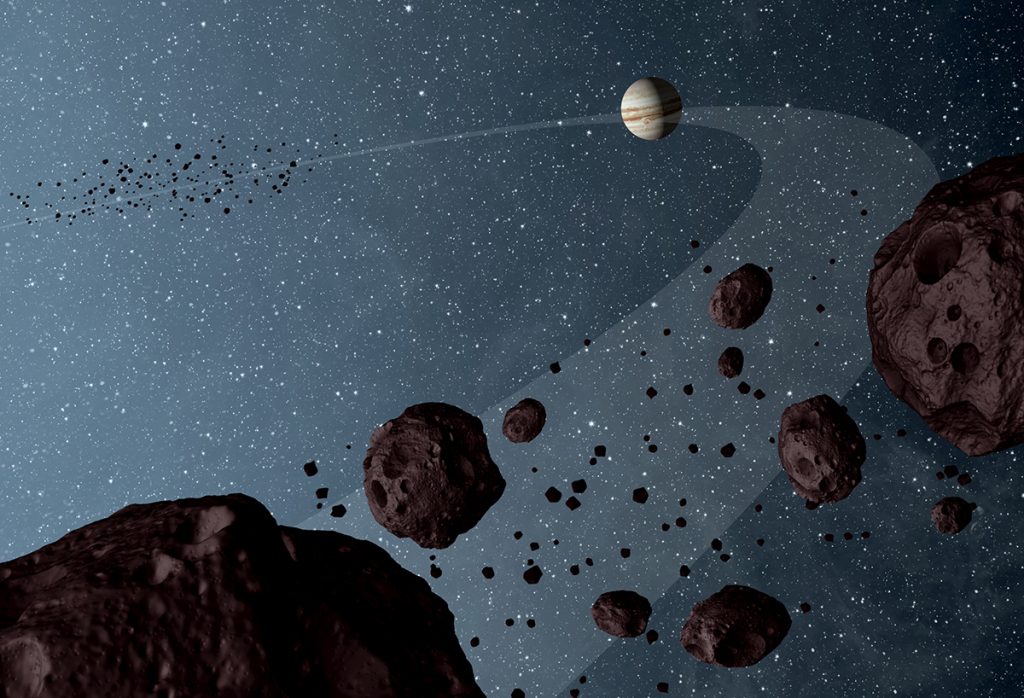
Hints of extraterrestrial life are being sought not just on Mars, but beyond this planet. In this regard, scientists think that the Trojan asteroids, which are considered mysterious space rocks, may hold clues of how our solar system evolved billions of years ago as they have remained gravitationally steady for a long time. The rocks have been caged in Jupiter’s orbit.
NASA/JPL-Caltech
2- NASA’s first attempt to Jupiter’s Trojan asteroids
The space agency’s Lucy mission will investigate these asteroids over the next 12 years, being NASA’s first-ever single spacecraft mission to explore scores of different asteroids, said the agency. According to NASA Administrator Bill Nelson, “Lucy embodies NASA’s enduring quest to push out into the cosmos for the sake of exploration and science, to better understand the universe and our place within it.” He said: “I can’t wait to see what mysteries the mission uncovers!”
[irp posts=”1964″ name=”Meet 2021 PH27, the Fastest Asteroid Found in the Solar System”]
3- Sophisticated trajectory of Lucy mission
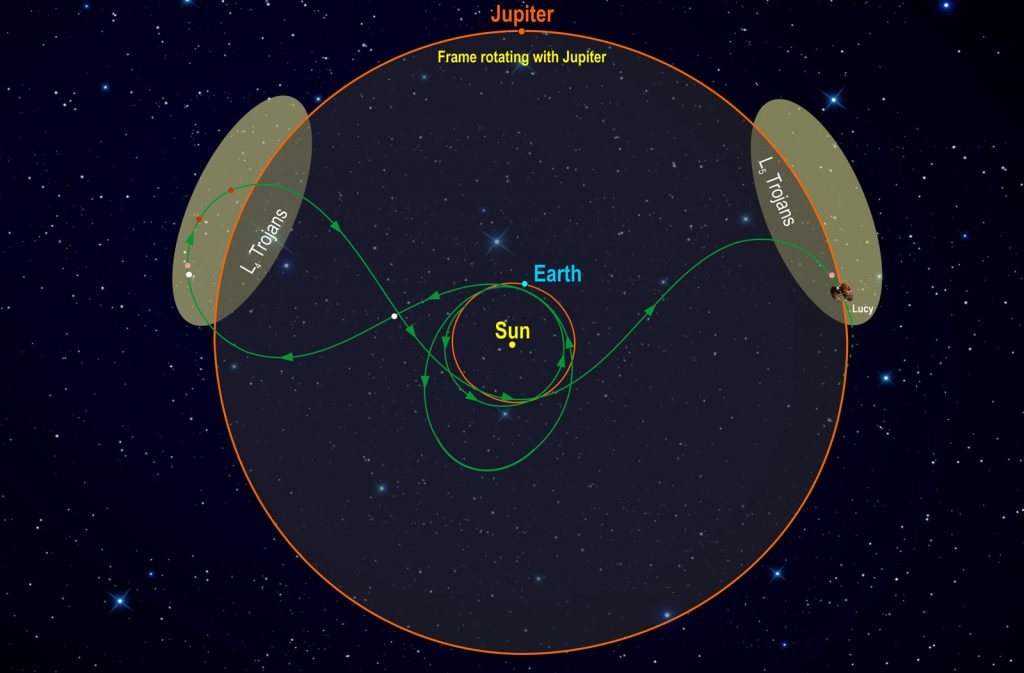
The asteroid hunter has a complicated trajectory for the purpose of having a gravity assist, with an average cruising speed of 39,000 mph. To pass each Trojan asteroid, it will be traveling 15,000 mph on average. Lucy will fly by seven Trojan asteroids as well as one main belt asteroid, said NASA. It will orbit the Sun and return to Earth in October 2022 when the spacecraft will be accelerated beyond the orbit of Mars.
Another gravity assist will take place in 2024 as Lucy will head back toward Earth to reach Donaldjohanson asteroid in 2025, of which its name comes from a paleoanthropologist at the Institute of Human Origins at Arizona State University. This asteroid located in the main asteroid belt in our solar system. To arrive in 2027, Lucy will be on the road to its first Trojan asteroid after the second attempt. Then, following the first four targeted flybys, the spacecraft will get back to Earth for a third gravity assist in 2031, which will push forward it to the Trojans for a 2033 encounter.
Southwest Research Institute
4- The reason why the Lucy will do multiple flybys
When it comes to space missions, especially a distant destination, to save fuel as much as possible is the main purpose as fuel delivery in space will mean extra costs. NASA explains this situation, “It takes a lot of rocket fuel to slow down and orbit an asteroid, and even more fuel to leave and do it multiple times.”
5- What Trojan asteroids will have flybys by Lucy?
Eurybates, Queta, Polymele, Leucus, Orus, Patroclus, and Menoetius. To note, most of the Trojan asteroids are named for heroes in The Illiad –an epic poem– that is attributed to Homer.
6- Instruments carried by Lucy
Lucy is carrying three scientific instruments: L’Ralp, L’LORRI, and L’TES. L’Ralph includes the spacecraft’s color camera, also known as the Multi-spectral Visible Imaging Camera (MVIC), and an imaging spectrometer in infrared, or the Linear Etalon Imaging Spectral Array (LEISA), which will detect the composition of materials located on the asteroids’ surfaces.
L’LORRI, or the Long Range Reconnaissance Imager, is the high spatial resolution camera imaging in black and white. As for L’TES — the far infrared Thermal Emission Spectometer– is the tool to measure the temperature of the surface.
Lucy fossil. Jason Kuffer
7- How will Lucy communicate with Earth?
This asteroid hunter will make contact with our planet through its High Gain Antenna. Moreover, it will also use its T2CAM — terminal tracking cameras — to trace asteroids in the course of encounters.
8- When will this mission come to an end?
NASA set the year 2033 as the end date of the Lucy mission. It will fade away in the vicinity of Jupiter.
9- Where does the name Lucy come from?
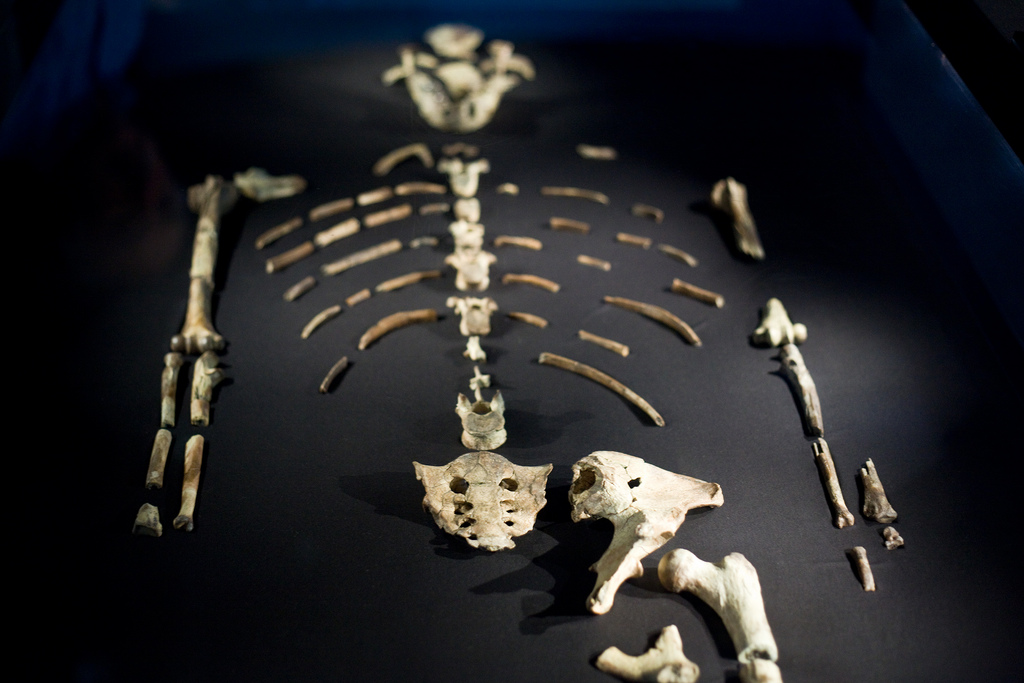
The spacecraft heading towards the Trojan asteroids is named after the Lucy fossil discovered in Hadar, Ethiopia by the team of anthropologist Donald Johanson.
WATCH: Designing Lucy’s path to the Trojan asteroids

Mariana Trench: 8 Fascinating Facts About the Earth’s Deepest Place

10 most famous scientists who contributed to astronomy and space

Top 25 extremely stunning photos of Northern Lights of 2020 revealed

Meteorite makes Indonesian man a millionaire as piece crashes through his roof

It’s Now Possible to Predict Blood Cancer With Ten-Second Videos

This Inexpensive Method Speeds up Analysis of 3D Printed Metal Parts

SpaceX Dragon: A Game Changer for NASA
Tiny fish, big boom: This small fish found to roar like a gunshot

Turkish city unveils design of Mars Colony project for tourists

Researchers Reveal the Source of the Electron Rain Phenomenon

A New Study Reveals How Climate Change Will Affect Sound Travels Underwater
Here Are 6 Space Technologies We Can Benefit to Improve Life on Earth

SpaceX Announced Crew Dragon Will No Longer Be Produced
Russia Warns Sanctions on Moscow Could Endanger the ISS
A New Study Reveals How to Make Walking Easier

Remote-control cars to race on the Moon in 2021

Space Debris Problem Is Getting Worse: Causes and Removal Efforts of Rambling Junk

Microplastic Pollution Detected in Human Blood for the First Time

Nvidia CEO declares coding’s end in AI era

Here Is Blue Origin’s Touristic Rocket: The New Shepard Design

The Fastest Manned Plane in the World: Here’s The Insane Engineering of the X-15
Here Are 6 Space Technologies We Can Benefit to Improve Life on Earth
Pentagon Formed A New Group To Investigate UFO Reports
Space Debris Problem Is Getting Worse: Causes and Removal Efforts of Rambling Junk
From New Zealand to the US: The Rocket Lab Story
Here Is Blue Origin’s Touristic Rocket: The New Shepard Design

Take a Look at Earth From Space: Glasgow, Scotland

NASA Is Preparing Next Generation Spacesuits for Moon Mission and Beyond
Remote-control cars to race on the Moon in 2021
Meteorite makes Indonesian man a millionaire as piece crashes through his roof
NASA sends a new Space toilet for astronauts to ISS

 Earth & Energy5 years ago
Mariana Trench: 8 Fascinating Facts About the Earth’s Deepest Place

 Space6 years ago
10 most famous scientists who contributed to astronomy and space
- Skywatching6 years ago
Top 25 extremely stunning photos of Northern Lights of 2020 revealed
- Engineering6 years ago
Meteorite makes Indonesian man a millionaire as piece crashes through his roof

 Science5 years ago
It’s Now Possible to Predict Blood Cancer With Ten-Second Videos
 Engineering5 years ago
This Inexpensive Method Speeds up Analysis of 3D Printed Metal Parts
- Infographic6 years ago
SpaceX Dragon: A Game Changer for NASA

 Earth & Energy3 years ago
Tiny fish, big boom: This small fish found to roar like a gunshot