
Space
Ready for Breakthroughs: Here’s the James Webb Launch Date
It’s happening this time.

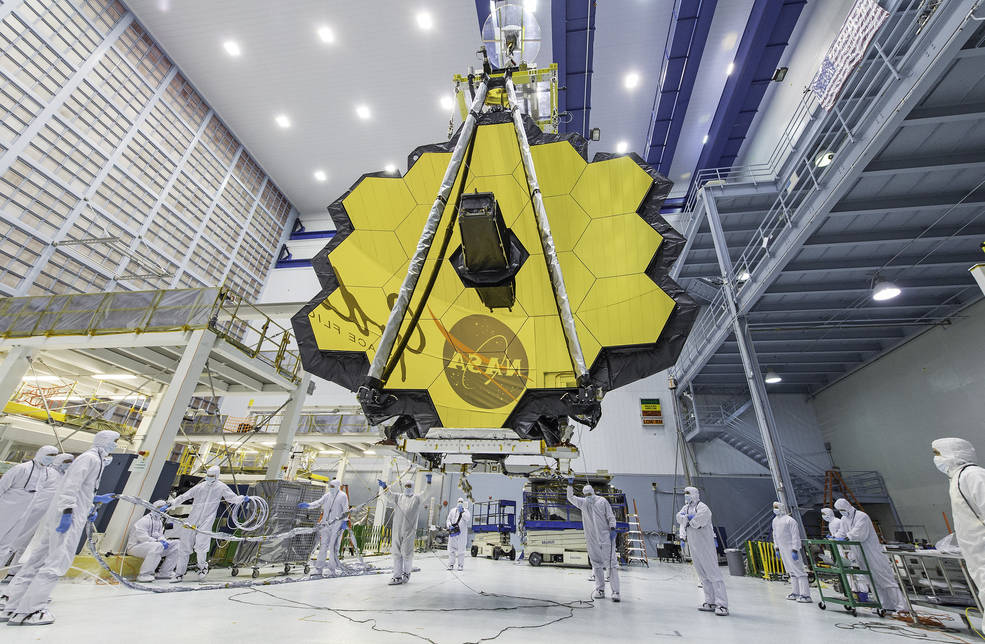
Previously, we reported that the James Webb Space Telescope was finally on its way to launch following multiple delays. And now, the countdown began for the James Webb launch date, which will take place on Dec 24, 2021.
The telescope will serve as a space-based infrared observatory aiming to do more than Hubble did, with its working capability at a longer wavelength and advanced sensitivity. European Space Agency, or ESA, announced that the James Webb was fueled inside the payload as part of launch preparation.
“Webb’s thrusters will use this propellant to make critical course corrections after separation from Ariane 5, to maintain its prescribed orbit about one and a half million kilometers from Earth, and to repoint the observatory and manage its momentum during operations,” said ESA.
Called a successor of Hubble, the space telescope will blast off from French Guiana on Arianespace’s Ariane 5 rocket, with a mission duration ranging from 5 to 10 years. You can take a glance at the details of the telescope just below.
Facts about the James Webb Space Telescope
| Launch Date: | December 24, 2021 – 07.20 a.m. EST |
| Launch Vehicle: | Ariane 5 |
| Mission Duration: | 5 – 10 years |
| Diameter of primary mirror: | 6.5 meters |
| Clear aperture of primary mirror: | 25 square meters |
| Primary mirror material: | Beryllium coated with gold |
| Mass of primary mirror: | 705 kg |
| Focal length: | 131.4 meters |
| Number of primary mirror segments: | 18 |
| Operating temperature: | under 50 K (-370 F) |
Source: NASA
James Webb launch date faced multiple delays
The $10 billion James Webb Space Telescope will make history as the largest, and most powerful telescope ever launched into space, according to ESA. The first James Webb launch date was scheduled for 2007; however, the plans did not work, and the giant telescope faced frequent delays causing cost increase.
NASA, meanwhile, is inviting people to register for a virtual event regarding the launch.
Named in honor of the pioneering astronomer Edwin Hubble, the Hubble Space Telescope that launched back in 1990 studies the universe mainly at optical and ultraviolet wavelengths. But the Webb will discover the depth of space in the infrared, settling 1.5 million kilometers away from Earth. Hubble is orbiting approximately 547 kilometers above our pale blue dot.
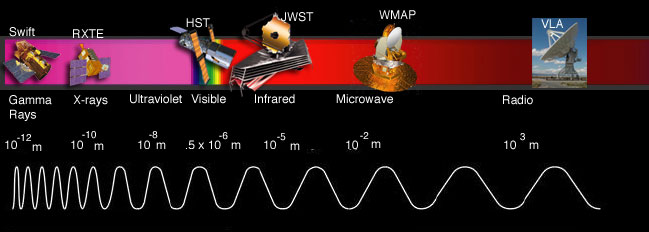
The electromagnetic spectrum and satellites. NASA

Mariana Trench: 8 Fascinating Facts About the Earth’s Deepest Place
10 most famous scientists who contributed to astronomy and space

Top 25 extremely stunning photos of Northern Lights of 2020 revealed

Meteorite makes Indonesian man a millionaire as piece crashes through his roof
It’s Now Possible to Predict Blood Cancer With Ten-Second Videos

This Inexpensive Method Speeds up Analysis of 3D Printed Metal Parts

SpaceX Dragon: A Game Changer for NASA
Tiny fish, big boom: This small fish found to roar like a gunshot

Turkish city unveils design of Mars Colony project for tourists

Researchers Reveal the Source of the Electron Rain Phenomenon
A New Study Reveals How Climate Change Will Affect Sound Travels Underwater
Here Are 6 Space Technologies We Can Benefit to Improve Life on Earth
SpaceX Announced Crew Dragon Will No Longer Be Produced
Russia Warns Sanctions on Moscow Could Endanger the ISS
A New Study Reveals How to Make Walking Easier

Remote-control cars to race on the Moon in 2021
Space Debris Problem Is Getting Worse: Causes and Removal Efforts of Rambling Junk

Microplastic Pollution Detected in Human Blood for the First Time

Nvidia CEO declares coding’s end in AI era
Here Is Blue Origin’s Touristic Rocket: The New Shepard Design
The Fastest Manned Plane in the World: Here’s The Insane Engineering of the X-15
Here Are 6 Space Technologies We Can Benefit to Improve Life on Earth
Pentagon Formed A New Group To Investigate UFO Reports
Space Debris Problem Is Getting Worse: Causes and Removal Efforts of Rambling Junk
From New Zealand to the US: The Rocket Lab Story
Here Is Blue Origin’s Touristic Rocket: The New Shepard Design
Take a Look at Earth From Space: Glasgow, Scotland
NASA Is Preparing Next Generation Spacesuits for Moon Mission and Beyond
Remote-control cars to race on the Moon in 2021
Meteorite makes Indonesian man a millionaire as piece crashes through his roof
NASA sends a new Space toilet for astronauts to ISS

 Earth & Energy5 years ago
Mariana Trench: 8 Fascinating Facts About the Earth’s Deepest Place

 Space6 years ago
10 most famous scientists who contributed to astronomy and space
- Skywatching6 years ago
Top 25 extremely stunning photos of Northern Lights of 2020 revealed
- Engineering6 years ago
Meteorite makes Indonesian man a millionaire as piece crashes through his roof

 Science5 years ago
It’s Now Possible to Predict Blood Cancer With Ten-Second Videos
 Engineering5 years ago
This Inexpensive Method Speeds up Analysis of 3D Printed Metal Parts
- Infographic6 years ago
SpaceX Dragon: A Game Changer for NASA

 Earth & Energy3 years ago
Tiny fish, big boom: This small fish found to roar like a gunshot